MCQ
A uniform spherical shell gradually shrinks maintaining its shape. The gravitational potential at the centre:
  • A
    Increases.
  • Decreases.
  • C
    Remains constant.
  • D
    Oscillates.

Answer

Correct option: B.
Decreases.
AS it is maintaining its shape so its mass will remain constant which implies that if it shrinks then its volume decreases and to keep the mass constant, its density increases. Also the gravitational potential at the centre of a uniform spherical shell is inversely proportional to the radius of the shell with a negative sign. When a uniform spherical shell gradually shrinks, the gravitational potential at the centre decreases (because of the negative sign in the formula of potential).

Need a full question paper?

Generate a complete, print-ready paper with questions like this in minutes — across 16+ boards, with answer keys.
Start Generating Free

Similar questions

An observer while going on scooter hears sound of two sirens of same frequencies from two opposite directions. If he travels along the direction of one of the siren, then he
An organ pipe $40\,cm$ long is open at both ends. The speed of sound in air is $360\,ms ^{-1}$. The frequency of the second harmonic is $...........\,Hz$.
The isothermal Bulk modulus of an ideal gas at pressure $P$ is
A fly wheel is accelerated uniformly from rest and rotates through $5 \,rad$ in the first second. The angle rotated by the fly wheel in the next second, will be.........$rad$
A particle of mass m is under the influence of a force $F$ which varies with the displacement $x$ according to the relation $F = - kx + {F_0}$ in which $k$ and ${F_0}$ are constants. The particle when disturbed will oscillate
There is a $1\, mm$ thick layer of glycerine between a flat plate of area $100\, cm^2$ and a big plate. If the coefficient of viscosity of glycerine is $1.0\, kg\, (m-s)$, then ....... $N$ force is required to move the plate with a velocity of $7\, cm/s$ .
A ball is projected upwards from a height $h$ above the surface of the earth with velocity $v$. The time at which the ball strikes the ground is
Spot the wrong statement :The acceleration due to gravity $‘g’$ decreases if
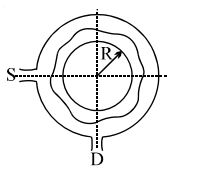
A narrow tube is bent in the form of a circle of radius $R,$ as shown in the figure. Two small holes $S$ and $D$ are made in the tube at the positions right angle to each other. A source placed at $S$ generated a wave of intensity $I_0$ which is equally divided into two parts : One part travels along the longer path, while the other travels along the shorter path. Both the part waves meet at the point $D$ where a detector is placed The maximum intensity produced at $D$ is given by
The escape velocities of two planets $A$ and $B$ are in the ratio $1: 2$. If the ratio of their radii respectively is $1: 3$, then the ratio of acceleration due to gravity of planet $A$ to the acceleration of gravity of planet $B$ will be: