A uniform spring of force constant $k$ is cut into two pieces, the lengths of which are in the ratio $1 : 2$. The ratio of the force constants of the shorter and the longer pieces is
Easy


Download our appand get started for free
Experience the future of education. Simply download our apps or reach out to us for more information. Let's shape the future of learning together!No signup needed.*
Similar Questions
- 1The motion of a simple pendulum excuting $S.H.M$. is represented by following equation.View Solution
$Y = A \sin (\pi t +\phi)$, where time is measured in $second$.
The length of pendulum is .............$cm$
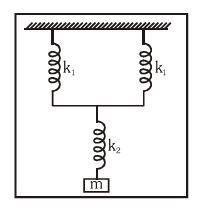
- 2View SolutionThe total spring constant of the system as shown in the figure will be
- 3View SolutionIn damped oscillation graph between velocity and position will be
- 4In an experiment to determine the period of a simple pendulum of length $1\, m$, it is attached to different spherical bobs of radii $r_1$ and $r_2$ . The two spherical bobs have uniform mass distribution. If the relative difference in the periods, is found to be $5\times10^{-4}\, s$, the difference in radii, $\left| {{r_1} - {r_2}} \right|$ is best given by .... $cm$View Solution
- 5A particle is performing simple harmonic motion with amplitude A and angular velocity ${\omega }$. The ratio of maximum velocity to maximum acceleration isView Solution
- 6A particle has simple harmonic motion. The equation of its motion is $x = 5\sin \left( {4t - \frac{\pi }{6}} \right)$, where $x$ is its displacement. If the displacement of the particle is $3$ units, then it velocity isView Solution
- 7The period of oscillation of a mass $M$ suspended from a spring of negligible mass is $T$. If along with it another mass $M$ is also suspended, the period of oscillation will now beView Solution
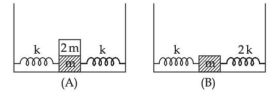
- 8In figure $(A),$ mass ' $2 m$ ' is fixed on mass ' $m$ ' which is attached to two springs of spring constant $k$. In figure $(B),$ mass ' $m$ ' is attached to two spring of spring constant ' $k$ ' and ' $2 k$ '. If mass ' $m$ ' in $(A)$ and $(B)$ are displaced by distance ' $x$ ' horizontally and then released, then time period $T_{1}$ and $T_{2}$ corresponding to $(A)$ and $(B)$ respectively follow the relation.View Solution
- 9A $S.H.M.$ is represented by $x = 5\sqrt 2 (\sin 2\pi t + \cos 2\pi t).$ The amplitude of the $S.H.M.$ is .... $cm$View Solution
- 10The displacement of a particle from its mean position (in metre) is given by $y = 0.2\sin (10\pi t + 1.5\pi )\cos (10\pi t + 1.5\pi )$. The motion of particle isView Solution