The displacement of a particle from its mean position (in metre) is given by $y = 0.2\sin (10\pi t + 1.5\pi )\cos (10\pi t + 1.5\pi )$. The motion of particle is
Medium
Download our app for free and get started
(c) $y = 0.2\sin (10\pi t + 1.5\pi )$$\cos (10\pi t + 1.5\pi )$
$ = 0.1\sin 2(10\pi \,t + 1.5\pi )$
$ = 0.1\sin (20\pi t + 3.0\pi )$
$\therefore$ Time period, $T = \frac{{2\pi }}{\omega } = \frac{{2\pi }}{{20\pi }} = \frac{1}{{10}} = 0.1sec$

Download our appand get started for free
Experience the future of education. Simply download our apps or reach out to us for more information. Let's shape the future of learning together!No signup needed.*
Similar Questions
- 1The angular amplitude of a simple pendulum is $\theta_0$. The maximum tension in its string will beView Solution
- 2A particle of mass $2 \,kg$, executing $SHM$ has amplitude $20 \,cm$ and time period $1 \,s$. Its maximum speed is ......... $m / s$View Solution
- 3An ideal spring with spring-constant $K$ is hung from the ceiling and a block of mass $M$ is attached to its lower end. The mass is released with the spring initially unstretched. Then the maximum extension in the spring isView Solution
- 4A brass cube of side $a$ and density $\rho$ is floating in mercury of density $\sigma$. If the cube is displaced a bit vertically, it executes $S.H.M.$ Its time period will beView Solution
- 5A particle of unit mass is moving along the $x$-axis under the influence of a force and its total energy is conserved. Four possible forms of the potential energy of the particle are given in column $I$ (a and $U _0$ are constants). Match the potential energies in column $I$ to the corresponding statement$(s)$ in column $II.$View Solution
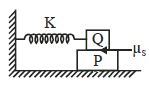
column $I$ column $II$ $(A)$ $U _1( x )=\frac{ U _0}{2}\left[1-\left(\frac{ x }{ a }\right)^2\right]^2$ $(P)$ The force acting on the particle is zero at $x = a$. $(B)$ $U _2( x )=\frac{ U _0}{2}\left(\frac{ x }{ a }\right)^2$ $(Q)$ The force acting on the particle is zero at $x=0$. $(C)$ $U _3( x )=\frac{ U _0}{2}\left(\frac{ x }{ a }\right)^2 \exp \left[-\left(\frac{ x }{ a }\right)^2\right]$ $(R)$ The force acting on the particle is zero at $x =- a$. $(D)$ $U _4( x )=\frac{ U _0}{2}\left[\frac{ x }{ a }-\frac{1}{3}\left(\frac{ x }{ a }\right)^3\right]$ $(S)$ The particle experiences an attractive force towards $x =0$ in the region $| x |< a$. $(T)$ The particle with total energy $\frac{ U _0}{4}$ can oscillate about the point $x=-a$. - 6A block $P$ of mass $m$ is placed on a smooth horizontal surface. A block $Q$ of same mass is placed over the block $P$ and the coefficient of static friction between them is ${\mu _S}$. A spring of spring constant $K$ is attached to block $Q$. The blocks are displaced together to a distance $A$ and released. The upper block oscillates without slipping over the lower block. The maximum frictional force between the block isView Solution
- 7A particle excutes $SHM$ on a straight line path. The amplitude of oscillation is $2\,cm$. When the displacement of the particle from the mean position is $1\,cm$, the numerical value of magnitude of acceleration is equal to the numerical value of magnitude of velocity. The frequency of $SHM$ is (in $second^{-1}$)View Solution
- 8A particle is executing $S.H.M.$ If its amplitude is $2 \,m$ and periodic time $2$ seconds, then the maximum velocity of the particle will beView Solution
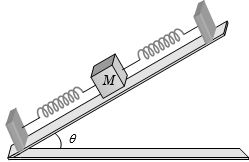
- 9On a smooth inclined plane, a body of mass $M$ is attached between two springs. The other ends of the springs are fixed to firm supports. If each spring has force constant $K$, the period of oscillation of the body (assuming the springs as massless) isView Solution
- 10Displacement between maximum potential energy position and maximum kinetic energy position for a particle executing $S.H.M.$ isView Solution