Question
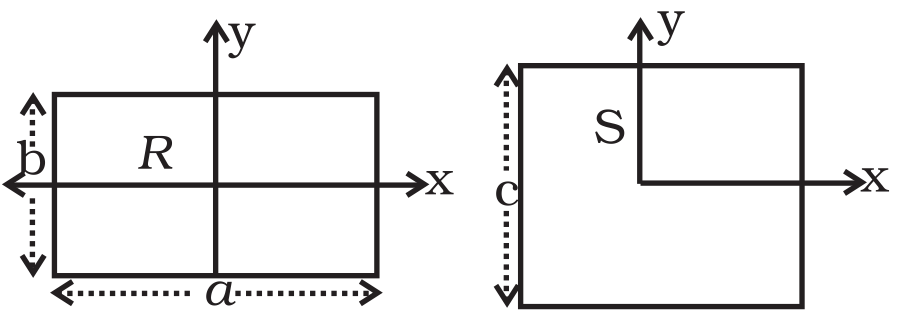
A uniform square plate S(side c) and a uniform rectangular plate R(sides b, a) have identical areas and masses:

Show that:
  1. $\frac{\text{I}_\text{xR}}{\text{I}_\text{xS}}<1$
  2. $\frac{\text{I}_\text{ys}}{\text{I}_\text{ys}}>1$
  3. $\frac{\text{I}_{2\text{R}}}{\text{I}_{2\text{s}}}>1$

Answer

According to the problem,

Area of square = Area of rectangular plate

⇒ c2 = a × b

⇒ c2 = ab

  1. $\frac{\text{I}_\text{XR}}{\text{I}_\text{XS}}=\frac{\text{b}^2}{\text{c}^2}$

It is clear from diagram that b < c.

$\Rightarrow\ \frac{\text{I}_\text{XR}}{\text{I}_\text{XS}}=\Big(\frac{\text{b}}{\text{c}}\Big)^2<1$

$\Rightarrow{\text{I}_\text{XR}}<{\text{I}_\text{XS}}$

  1. $\frac{\text{I}_\text{YR}}{\text{I}_\text{RS}}=\frac{\text{a}^2}{\text{c}^2}$ (It is clear that a > c)

$\Rightarrow\ \frac{\text{I}_\text{YR}}{\text{I}_\text{RS}}=\Big(\frac{\text{a}}{\text{c}}\Big)^2>1$

  1. $\text{I}_\text{zR}=\frac{1}{12}\text{M}(\text{a}^2+\text{b}^2)$

$\Rightarrow\ \text{I}_\text{zS}=\frac{1}{12}\text{M}(\text{c}^2+\text{c}^2)$

Now, $\text{I}_\text{zR}-\text{I}_\text{zS}=\frac{1}{12}\text{M}\big[\text{a}^2+\text{b}^2-2\text{c}^2\big]$

$\Rightarrow\ \text{I}_\text{zR}-\text{I}_\text{zS}=\frac{1}{12}\text{M}\big(\text{a}^2+\text{b}^2-2\text{ab}\big)$

$\Rightarrow\ \text{I}_\text{zR}-\text{I}_\text{zS}=\frac{1}{12}\text{M}\big(\text{a}-\text{b}\big)^2>0$

$\Rightarrow\ \frac{\text{I}_\text{zR}}{\text{I}_\text{zS}}>1$
Need a full question paper?

Generate a complete, print-ready paper with questions like this in minutes — across 16+ boards, with answer keys.

Start Generating Free

Similar questions

0.040g of He is kept in a closed container initially at 100.0°C. The container is now heated. Neglecting the expansion of the container, calculate the temperature at which the internal energy is increased by 12J.
How much energy is radiated per minute from the filament of incandescent lamp at 3000K if the surface area is 10-4m2 and its emissivity is 0.4? Stefan's constant
 = 5.67 × 10-8 Wm-2K-4.
Explain the Newton's law of gravity. Write the value, unit and dimension of universal constant of gravitation. Why is it called universal? Or Write Newton's law of gravity. Define universal gravitational constant (G). Also write its units and dimensional formula.
A tuning fork of unknown frequency makes 5 beats per second with another tuning fork which can cause a closed organ pipe of length 40cm to vibrate in its fundamental mode. The beat frequency decreases when the first tuning fork is slightly loaded with wax. Find its original frequency. The speed of sound in air is 320m/s.
Define moment of inertia of a body. Give its units and dimensions. What is the physical significance of moment of inertia?
Suppose the ceiling in the previous problem is that of an elevator which is going up with an acceleration of 2.0m/s2. Find the elongations.
A right-angled triangle abc, made from a metallic wire, moves at a uniform speed v in its plane as shown in figure. A uniform magnetic field B exists in the perpendicular direction. Find the emf induced:
  1. In the loop abc.
  2. In the segment bc.
  3. In the segment ac.
  4. In the segment ab.

Separation of Motion of a system of particles into motion of the centre of mass and motion about the centre of mass:
Show $\text{p}=\text{p}'_\text{i}+\text{m}_\text{i}\text{V}$ where pi is the momentum of the ith particle (of mass mi ) and p′i = miv′i.
Note: v′i is the velocity of the ith particle relative to the centre of mass. Also, prove using the definition of the centre of mass.
Prove the result that the velocity v of translation of a rolling body (like a ring, disc, cylinder or sphere) at the bottom of an inclined plane of a height h is given by $\text{v}^2=\frac{2\text{gh}}{\Big(\frac{1+\text{k}^2}{\text{R}^2}\Big)}$ using dynamical consideration (i.e. by consideration of forces and torques).
Note: k is the radius of gyration of the body about its symmetry axis, and R is the radius of the body. The body starts from rest at the top of the plane.
If a drop of liquid breaks into smaller droplets, it results in lowering of temperature of the droplets. Let a drop of radius R, break into N small droplets each of radius r. Estimate the drop in temperature.