Question
A unit charge moves on an equipotential surface from a point A to point B, then:

Answer

  1. VA - VB = 0.

Need a full question paper?

Generate a complete, print-ready paper with questions like this in minutes — across 16+ boards, with answer keys.
Start Generating Free

Similar questions

Bohrs atomic model assumes:
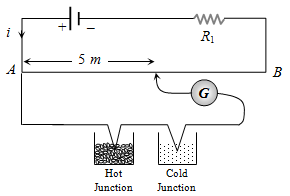
In the following circuit a $10 m$ long potentiometer wire with resistance $1.2 \ \text{ohm/m},$ a resistance $R_1$ and an accumulator of emf $2 V$ are connected in series. When the $\text{emf}$ of thermocouple is $2.4 \ \text{mV}$ then the deflection in galvanometer is zero. The current supplied by the accumulator will be
A capacitor becomes a perfect insulator for:
Which quantity decrease in step-down transformer ?
Two lenses are placed in contact with each other and the focal length of combination is 80 cm. If the focal length of one is 20 cm, then the power of the other will be(a) 1.66 D(b) 4.00 D(c) –1.00 D(d) – 3.75 D
       
From the following, what charges can be present on oil drops in Millikan's experiment $($Here e is the electronic charge$)$
A metallic particle having no net charge is placed near a finite metal plate carrying a positive charge. The electric force on the particle will be:
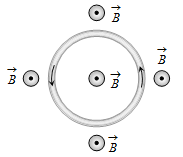
An elastic circular wire of length $l$ carries a current $I.$ It is placed in a uniform magnetic field  $\overrightarrow{ B } ($Out of paper$)$ such that its plane is perpendicular to the direction of $\overrightarrow{ B }$. The wire will experience
Capacitance of a parallel plate capacitor becomes 4/3 times its original value if a dielectric slab of thickness t = d/2 is inserted between the plates (d is the separation between the plates). The dielectric constant of the slab is(a) 8 (b) 4(c) 6  (d) 2
       
Assertion : The electrical conductivity of earth’s atmosphere decrease with altitude.
Reason     : The high energy particles (i.e. g-rays and cosmic rays) coming from outer space and entering our earth’s atmosphere causes ionisation of the atoms of the gases present there and the pressure of gases decreases with increase in altitude.(a) If both assertion and reason are true and the reason is the correct explanation of the assertion.(b) If both assertion and reason are true but reason is not the correct explanation of the assertion.(c) If assertion is true but reason is false.(d) If assertion is false but reason is true.