MCQ
A unitless quantity?
  • A
    Does not exist
  • B
    Always has a nonzero dimension
  • Never has a nonzero dimension
  • D
    May have a nonzero dimension

Answer

Correct option: C.
Never has a nonzero dimension
c
Dimensions of a quantity are those power to which the fundamental quantities are raised and then multiplied among each other to become equal to the quantity which we are dealing. A unit less quantity is the one in which there are no fundamental quantities involved. It doesn't have any unit and hence it doesn't have any dimensions. The dimension is Zero. Examples are, angle, elastic strain, Poisson's ratio etc.

Need a full question paper?

Generate a complete, print-ready paper with questions like this in minutes — across 16+ boards, with answer keys.
Start Generating Free

Similar questions

A body of mass $1\, kg$ is moving in a vertical circular path of radius $1\,m$. The difference between the kinetic energies at its highest and lowest position is ......... $J$
The volume of an air bubble becomes three times as it rises from the bottom of a lake to its surface. Assuming atmospheric pressure to be $75 cm$  of $Hg $ and the density of water to be $1/10$  of the density of mercury, the depth of the lake is ....... $m$
A star of mass $M$ and radius $R$ is made up of gases. The average gravitational pressure compressing the star due to gravitational pull of the gases making up the star depends on $R$ as
Two resistors ${R}_{1}=(4 \pm 0.8) \Omega$ and ${R}_{2}=(4 \pm 0.4)$ $\Omega$ are connected in parallel. The equivalent resistance of their parallel combination will be
An ideal gas is that which can:
Third harmonic frequency in open argonpipe:
Certain neutron stars are believed to be rotating at about $1\,rev/\sec $. If such a star has a radius of $ 20\, km$, the acceleration of an object on the equator of the star will be
Which of the following is the most precise device for measuring length 
A block of ice at $- 10°C$ is slowly heated and converted to steam at $100°C.$ Which of the following curves represents the phenomenon qualitatively
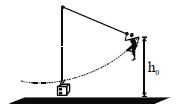
Starting from rest on her swing at initial height $h_0$ above the ground, Saina swings forward. At the lowest point of her motion, she grabs her bag that lies on the ground. Saina continues swinging forward to reach maximum height $h_1$ . She then swings backward and when reaching the lowest point of motion again, she simple lets go off the bag, which falls freely. Saina's backward swing then reaches maximum height $h_2$ . Neglecting air resistance, how are the three heights related?