Question
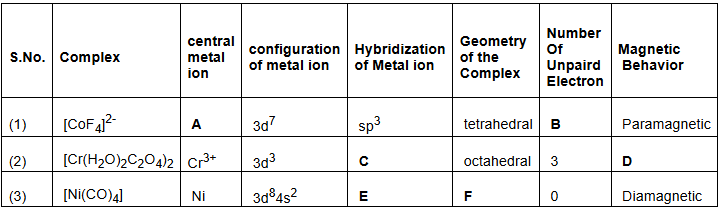
$(a).$ Using, Valence Bond Theory identify $\ce{A, B, C, D, E}$ and $\ce{F}$ in the following table$:$​​​​​​​
Image
$(b).$ Write the ionic equations for the reaction of acidified $\ce{K_2Cr_2O_7}$ with
$\ce{(i) H_2S}$ and $\ce{(ii) FeSO_4}​​​​​​​$​​​​​​​

Answer

$(a).A = Co^{2+}$
$B = 3$
$C = d^2sp^3$
$D =$ Paramagnetic
$E = sp^3$
$F =$ tetrahedral
$\ce{(b). (i) Cr_2O_7^{2-} + 8 H^+ + 3 H_2S \rightarrow 2 Cr^{3+} + 3S + 7 H_2O}$
$\ce{(ii) Cr_2O_7^{2-} + 14 H^+ 6 Fe^{2+} 2 Cr^{3+} + 6 Fe^{3+} + 7 H_2O}$

Need a full question paper?

Generate a complete, print-ready paper with questions like this in minutes — across 16+ boards, with answer keys.

Start Generating Free

Similar questions

Write a detailed note on enzymes.
Using crystal field theory, draw energy level diagram, write the electronic configuration of the central metal atom/ion and determine the magnetic moment value in the following:
i. $\left[ CoF _6\right]^{3-},\left[ Co \left( H _2 O \right)_6\right]^{2+},\left[ Co ( CN )_6\right]^{3-}$
ii. $\left[ FeF _6\right]^{3-},\left[ Fe \left( H _2 O \right)_6\right]^{2+},\left[ Fe ( CN )_6\right]^{4-}$
Match the solutions given in Column $I$ and the colours given in Column $II.$
 
Column $I ($Aqueous solution of salt$)$
 
Column $II($Colour$)$
$(i)$ $\ce{FeSO_4.7H_2O}$ $(a)$
Green
$(ii)$ $\ce{NiCl_2.4H_2O}$ $(b)$
Light pink
$(iii)$ $\ce{MnCl_2.4H_2O}$ $(c)$
Blue
$(iv)$ $\ce{CoCl_2.6H_2O}$ $(d)$
Pale green
$(v)$ $\ce{Cu_2Cl_2}$ $(e)$
Pink
 
 
$(f)$
Colourless
$FeSO_4$ solution mixed with $\left( NH _4\right)_2 SO _4$ solution in $1:1$ molar ratio gives the test of $Fe ^{2+}$ ion but $CuSO _4$ solution mixed with aqueous ammonia in $1: 4$ molar ratio does not give the test of $Cu ^{2+}$ ion. Explain why?
Describe the structure of a fuel cell. Draw labelled diagram of a structure of fuel cell?
How will you obtain the following compounds from ethyl alcohol? Explain with equation :
(i) Diethyl ether
(ii) Iodoform
(iii) Ethyl acetate
(iv) Acetaldehyde
  1. Define the following terms:
  1. Mole fraction.
  2. Van’t Hoff factor.
  1. $100\ mg$ of a protein is dissolved in enough water to make $10.0\ mL$ of a solution. If this solution has an osmotic pressure of $13.3\ mm\ Hg$ at $25^\circ C,$ what is the molar mass of protein$?$
$(R = 0.0821\ L\ atm\ mol^{–1} K^{–1}$ and $760\ mm\ Hg = 1\ atm.)$
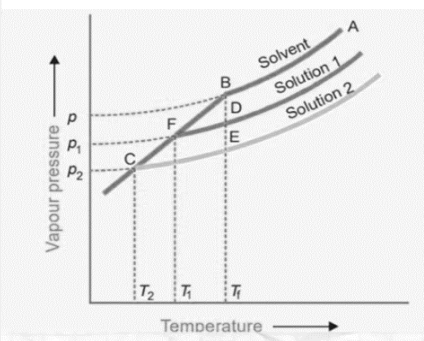
$(a).$ An experiment was carried out in the laboratory, to study depression in freezing point. $1M$ aqueous solution of $Al(NO_3)_3$ and $1\ M$ aqueous solution of glucose were taken. From the given figure identify solution $1$ and solution $2.$ Give a plausible reason for your answer
Image
$(b).$ The osmotic pressure of a solution of cane sugar was found to be $2.46$ atm at $300 K.$ If the solution was diluted five times, calculate the osmotic pressure at the same temperature.
How can the osmotic pressure of the given cane sugar solution be decreased without changing its volume? Give a reason for your answer.
Answer the following questions.
Write chemical reaction to show that glucose contains aldehyde as carbonyl group.
Match the items of Column I and Column II.
  Column I   Column II
(i) Mathematical expression for rate of reaction. (a) Rate constant.
(ii) Rate of reaction for zero order reaction is equal to. (b) Rate law.
(iii) Units of rate constant for zero order reaction is same as that of. (c) Oder of slowest step.
(iv) Order of a complex reaction is determined by. (d) Rate of a reaction.