Static friction between two surfaces
Easy
Download our app for free and get started
(a)

Download our appand get started for free
Experience the future of education. Simply download our apps or reach out to us for more information. Let's shape the future of learning together!No signup needed.*
Similar Questions
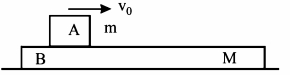
- 1The masses of blocks A and B are $m$ and $M$ respectively. Between $A$ and $B$, there is a constant frictional force $F$ and $B$ can slide on a smooth horizontal surface. A is set in motion with velocity while $B$ is at rest. What is the distance moved by A relative to $B$ before they move with the same velocity?View Solution
- 2A lift is moving downwards with an acceleration equal to acceleration due to gravity. $A$ body of mass $M$ kept on the floor of the lift is pulled horizontally. If the coefficient of friction is $\mu $, if the lift is moving upwards with a uniform velocity, then the frictional resistance offered by the body isView Solution
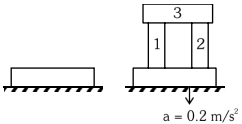
- 3A steel block of $10\, {kg}$ rests on a horizontal floor as shown. When three iron cylinders are placed on it as shown, the block and cylinders go down with an acceleration $0.2\, {m} / {s}^{2}$. The normal reaction ${R}$ by the floor if mass of the iron cylinders are equal and of $20\, {kg}$ each, is .....$N.$ [Take ${g}=10\, {m} / {s}^{2}$ and $\mu_{{s}}=0.2$ ]View Solution
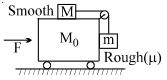
- 4Imagine $a$ situation in which the horizontal surface of block $M_0$ is smooth and its vertical surface is rough with $a$ coefficient of friction $\mu$ In above problem, the value $(s)$ of $F$ for which $M$ and $m$ are stationary with respect to $M_0 mg$View Solution
- 5View SolutionMeena applies the front brakes, while riding on her bicycle along a flat road. The force that slows her bicycle is provided by the
- 6A body of $10\, kg$ is acted by a force of $129.4\, N$ if $g = 9.8\,m/{\sec ^2}$. The acceleration of the block is $10\,m/{s^2}$. What is the coefficient of kinetic frictionView Solution
- 7View SolutionA car when passes through a convex bridge exerts a force on it which is equal to
- 8View SolutionWhen a bicycle is in motion, the force of friction exerted by the ground on the two wheels is such that it acts
- 9A block of mass $m$ is placed on a surface having vertical cross section given by $y=x^2 / 4$. If coefficient of friction is $0.5$ , the maximum height above the ground at which block can be placed without slipping is:View Solution
- 10View SolutionA metal block is resting on a rough wooden surface. A horizontal force applied to the block is increased uniformly. Which of the following curves correctly represents velocity of the block ?