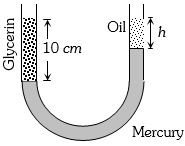
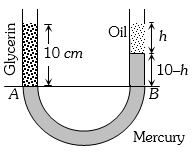
A vertical $U-$ tube of uniform inner cross section contains mercury in both sides of its arms. A glycerin (density = $1.3 g/cm^3$) column of length $10 $ $cm $ is introduced into one of its arms. Oil of density $0.8 gm/cm^3$ is poured into the other arm until the upper surfaces of the oil and glycerin are in the same horizontal level. Find the length of the oil column ........ $cm$. Density of mercury = $13.6 g/cm^3$
Medium


Download our appand get started for free
Experience the future of education. Simply download our apps or reach out to us for more information. Let's shape the future of learning together!No signup needed.*
Similar Questions
- 1Two uniform solid balls of same density and of radii $r$ and $2r$ are dropped in air and fall vertically downwards. The terminal velocity of the ball with radius $r$ is $1\,cm\,s^{-1}$ , then find the terminal velocity of the ball of radius $2r$ (neglect bouyant force on the balls.) ........... $cm\,s^{-1}$View Solution
- 2Which of the following is the incorrect graph for a sphere falling in a viscous liquid? (Given at $t = 0$, velocity $v = 0$ and displacement $x = 0$.)View Solution
- 3An air bubble of volume $1\,cm ^3$ rises from the bottom of a lake $40\,m$ deep to the surface at a temperature of $12^{\circ}\,C$. The atmospheric pressure is $1 \times 10^5 Pa$, the density of water is $1000\,kg / m ^3$ and $g =10\,m / s ^2$. There is no difference of the temperature of water at the depth of $40\,m$ and on the surface. The volume of air bubble when it reaches the surface will be $..........\,cm^{3}$View Solution
- 4A water drop of radius $1\,\mu m$ falls in a situation where the effect of buoyant force is negligible. Coefficient of viscosity of air is $1.8 \times 10^{-5}\,Nsm ^{-2}$ and its density is negligible as compared to that of water $10^{6}\,gm ^{-3}$. Terminal velocity of the water drop is________ $\times 10^{-6}\,ms ^{-1}$View Solution
(Take acceleration due to gravity $=10\,ms ^{-2}$ )
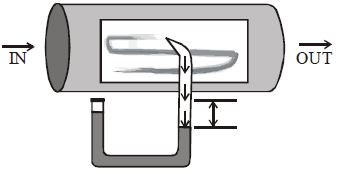
- 5The Pitot tube shown in the figure is used to measure fluid flow velocity in a pipe of cross sectional area $S$. It was invented by a French engineer Henri Pitot in the early $18^{th}$ century. The volume of the gas flowing across the section of the pipe per unit time is (The difference in the liquid columns is $\Delta h, \rho_0$ and $\rho$ are the densities of liquid and the gas respectively) :-View Solution
- 6A flat plate moves normally with a speed ${v_1}$ towards a horizontal jet of water of uniform area of cross-section. The jet discharges water at the rate of volume $V$ per second at a speed of ${v_2}$. The density of water is $\rho $. Assume that water splashes along the surface of the plate at right angles to the original motion. The magnitude of the force acting on the plate due to the jet of water isView Solution
- 7A body of density $\rho$ is dropped from rest from a height $h$ into a lake of density $\sigma$, where $\sigma > \rho$. Neglecting all dissipative forces, the maximum depth to which the body sinks before returning to float on surface ..........View Solution
- 8View SolutionThe weight of an aeroplane flying in air is balanced by
- 9$Assertion : $ Machine parts are jammed in winter.View Solution
$Reason :$ The viscosity of lubricant used in machine parts increase at low temperatures. - 10A fully loaded boeing aircraft has a mass of $5.4 \times 10^5\,kg$. Its total wing area is $500\,m ^2$. It is in level flight with a speed of $1080\,km / h$. If the density of air $\rho$ is $1.2\,kg\,m ^{-3}$, the fractional increase in the speed of the air on the upper surface of the wing relative to the lower surface in percentage will be $\left( g =10\,m / s ^2\right)$View Solution