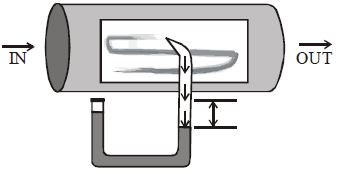
The Pitot tube shown in the figure is used to measure fluid flow velocity in a pipe of cross sectional area $S$. It was invented by a French engineer Henri Pitot in the early $18^{th}$ century. The volume of the gas flowing across the section of the pipe per unit time is (The difference in the liquid columns is $\Delta h, \rho_0$ and $\rho$ are the densities of liquid and the gas respectively) :-
Diffcult
Download our app for free and get started
Applying Bernoulli's theorem
$P _{ A }= P _{ B }+\frac{1}{2} \rho v ^2 \text { as, } v _{ A }=0$
$\frac{1}{2} \rho v^2=P_A-P_B=\Delta h_0 g$
So, $v=\sqrt{\frac{2 \Delta h \rho_0 g}{\rho}}$
Thus, rate of flow of gas, $Q = Sv = S \sqrt{\frac{2 \Delta h \rho g }{\rho}}$

Download our appand get started for free
Experience the future of education. Simply download our apps or reach out to us for more information. Let's shape the future of learning together!No signup needed.*
Similar Questions
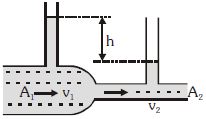
- 1A liquid flows through a horizontal tube. The velocities of the liquid in the two sections which have areas of cross-section $A_1$ and $A_2$ are $v_1$ and $v_2$ respectively. The difference in the levels of the liquid in the two vertical tubes is $h$ . The incorrect statement isView Solution
- 2Different heads are in Column - $\mathrm{I}$ and its formulas are given in Column - $\mathrm{II}$. Match them appropriately.View Solution
Column - $\mathrm{I}$ Column - $\mathrm{II}$ $(a)$ Velocity head $(i)$ $\frac{P}{{\rho g}}$ $(b)$ Pressure head $(ii)$ $h$ $(iii)$ $\frac{{{v^2}}}{{2g}}$ - 3Different processes are given in Column - $\mathrm{I}$ and its reasons are given in Column - $\mathrm{II}$. Match the appropriately.View Solution
Column - $\mathrm{I}$ Column - $\mathrm{II}$ $(a)$Rain drops moves downwards with constant velocity. $(i)$ Viscous liquids $(b)$ Floating clouds at a height in air. $(ii)$ Viscosity $(iiii)$ Less density - 4Given below are two statements:View Solution
Statement $I :$ Pressure in a reservoir of water is same at all points at the same level of water.
Statement $II :$ The pressure applied to enclosed water is transmitted in all directions equally.
In the light of the above statements, choose the correct answer from the options given below:
- 5Three identical vessels are filled to the same height with three different liquids $A, B$ and $C$ $({\rho _A} > {\rho _B} > {\rho _C})$. The pressure at the base will beView Solution
- 6A plastic circular disc of radius $R$ is placed on a thin oil film, spread over a flat horizontal surface. The torque required to spin the disc about its central vertical axis with a constant angular velocity is proportional toView Solution
- 7Three liquids of densities $d,\,2d$ and $3d$ are mixed in equal volumes. Then the density of the mixture isView Solution
- 8View SolutionThe term 'fluid' is used for ............
- 9The atmospheric pressure at a place is $10^5 \,Pa$. If tribromomethane (specific gravity $=2.9$ ) be employed as the barometric liquid, the barometric height is .......... $m$View Solution
- 10There is a hole in the bottom of tank having water. If total pressure at bottom is $ 3 atm$ ($1 atm = 10^5N/m^2$) then the velocity of water flowing from hole isView Solution