MCQ
A very broad elevator is going up vertically with a constant acceleration of $2\,m / s ^2$. At the instant when its velocity is $4\,m / s$ a ball is projected from the floor of the lift with a speed of $4\,m / s$ relative to the floor at an elevation of $30^{\circ}$. The time taken by the ball to return the floor is $..............\,s$ $\left(g=10\,m / s ^2\right)$
  • A
    $\frac{1}{2}$
  • $\frac{1}{3}$
  • C
    $\frac{1}{4}$
  • D
    $1$

Answer

Correct option: B.
$\frac{1}{3}$
b
(b)

Let us see the motion relative to elevator,

$a_r=a_b-a_e=(-10)-(+2)=-12\,m / s ^2$

Now,

$T =\frac{2 u_y}{a_r}=\frac{2 \times u \sin \theta}{a_r}$

$=\frac{2 \times 4 \times \sin 30^{\circ}}{12}=\frac{1}{3}\,s$

Need a full question paper?

Generate a complete, print-ready paper with questions like this in minutes — across 16+ boards, with answer keys.

Start Generating Free

Similar questions

Two identical beakers $A$ and $B$ contain equal volumes of two different liquids at $60\,^oC$ each and left to cool down. Liquid in $A$ has density of $8 \times10^2\, kg / m^3$ and specific heat of $2000\, Jkg^{-1}\,K^{-1}$ while liquid in $B$ has density of $10^3\,kgm^{-3}$ and specific heat of $4000\,JKg^{-1}\,K^{-1}$ . Which of the following best describes their temperature versus time graph schematically? (assume the emissivity of both the beakers to be the same)
The Bhagirathi and the Alaknanda merge at Deoprayag to form the Ganga with their speeds in the ratio $1: 1: 5$. The cross-sectional areas of the Bhagirathi, the Alaknanda and the Ganga are in the ratio $1: 2: 3$. Assuming streamline flow, the ratio of the speed of Ganga to that of the Alaknanda is
The least count of a stop watch is $\frac{1}{5}$ second. The time of $20$ oscillations of a pendulum is measured to be $25$ seconds. The maximum percentage error ig the measurement of time will be ..... $\%$
A $metre$ scale is suspended vertically from a horizontal axis passing through one end of it. Its time period would be ....... $\sec$
A large horizontal surface moves up and down in $S.H.M.$ with an amplitude of $1\, cm$. If a mass of $10\, kg$ (which is placed on the surface is to remain continuously in contact with it, the maximum frequency of $S.H.M.$ will be .... $Hz$
A circular loop of area $1 \mathrm{~cm}^2$, carrying a current of $10 A$ , is placed in a magnetic field of $0.1 T$ perpendicular to the plane of the loop. The torque on the loop due to the magnetic field is:
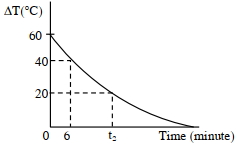
In an experment ot verify Newton's law of cooling, a graph is plotted between, the temperature difference $(\Delta T )$ of the water and surroundings and time as shown in figure. The initial temperature of water is taken as $80^{\circ} \,C$. The value of $t _{2}$ as mentioned in the graph will be...........
In $S = a + bt + c{t^2}$. $S$ is measured in metres and $t$ in seconds. The unit of $c$ is
The speed of a transverse wave passing through a string of length $50 \;cm$ and mass $10\,g$ is $60\,ms ^{-1}$. The area of cross-section of the wire is $2.0\,mm ^{2}$ and its Young's modulus is $1.2 \times 10^{11}\,Nm ^{-2}$. The extension of the wire over its natural length due to its tension will be $x \times 10^{-5}\; m$. The value of $x$ is $...$
A vector $\vec A $ is rotated by a small angle $\Delta \theta$ radian $( \Delta \theta << 1)$ to get a new vector $\vec B$ In that case $\left| {\vec B - \vec A} \right|$ is