A very thin metallic shell of radius $r$ is heated to temperature $T$ and then allowed to cool. The rate of cooling of shell is proportional to ........
Easy
Download our app for free and get started
(d)
Rate of cooling depends on temperature of body, surrounding temperature, not on radius.

Download our appand get started for free
Experience the future of education. Simply download our apps or reach out to us for more information. Let's shape the future of learning together!No signup needed.*
Similar Questions
- 1If a metallic sphere gets cooled from ${62^o}C$ to ${50^o}C$ in ${40^o}C$and in the next $10\;\min utes$gets cooled to ${42^o}C$, then the temperature of the surroundings is ......... $^oC$View Solution
- 2View SolutionOn heating one end of a rod, the temperature of whole rod will be uniform when
- 3The wavelength of maximum energy released during an atomic explosion was $2.93 \times {10^{ - 10}}m$. Given that Wein's constant is $2.93 \times {10^{ - 3}}m - K$, the maximum temperature attained must be of the order ofView Solution
- 4View SolutionGravitational force is required for
- 5View SolutionWhen the body has the same temperature as that of surroundings
- 6A container contains hot water at ${100^o}C$. If in time ${T_1}$ temperature falls to ${80^o}C$ and in time ${T_2}$ temperature falls to ${60^o}C$ from ${80^o}C$, thenView Solution
- 7A black body radiates energy at the rate of $E$ $W/m^2$ at a high temperature $TK$ . When the temperature is reduced to $\frac{T}{2}K$, the radiant energy will beView Solution
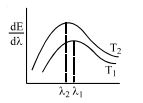
- 8The spectral emissive power $E_\lambda $ for a body at temperature $T_1$ is plotted against the wavelength and area under the curve is found to be $A$. At a different temperature $T_2$ the area is found to be $9A$. Then $\lambda _1/\lambda _2 =$View Solution
- 9The energy emitted per second by a black body at $27^o\ C$ is $10\ J$. If the temperature of the black body is increased to $327^o\ C$ , the energy emitted per second will be ......... $J$View Solution
- 10In a certain planetary system, it is observed that one of the celestial bodies having a surface temperature of $200 \;K$, emits radiation of maximum intensity near the wavelength $12\; \mu m$. The surface temperature (in $K$) of a nearby star which emits light of maximum intensity at a wavelength $\lambda= 4800\;\mathring A$ isView Solution