The wavelength of maximum energy released during an atomic explosion was $2.93 \times {10^{ - 10}}m$. Given that Wein's constant is $2.93 \times {10^{ - 3}}m - K$, the maximum temperature attained must be of the order of
AIIMS 2010, Medium


Download our appand get started for free
Experience the future of education. Simply download our apps or reach out to us for more information. Let's shape the future of learning together!No signup needed.*
Similar Questions
- 1A hollow copper sphere $S$ and a hollow copper cube $ C$ , both of negligible thin walls of same area, are filled with water at $90°C$ and allowed to cool in the same environment. The graph that correctly represents their cooling isView Solution
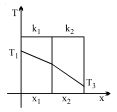
- 2The temperature drop through each layer of a two layer furnace wall is shown in figure. Assume that the external temperature $T_1$ and $T_3$ are maintained constant and $T_1 > T_3$. If the thickness of the layers $x_1$ and $x_2$ are the same, which of the following statements are correct.View Solution
- 3The top of a lake gets frozen at a place where the surrounding air is at a temperature of $-20\,^oC$. ThenView Solution
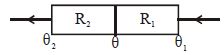
- 4Consider two insulating sheets with thermal resistances $R_1$ and $R_2$ as shown. The temperatures $\theta $ isView Solution
- 5A hot body, obeying Newton's law of cooling is cooling down from its peak value $80\,^oC$ to an ambient temperature of $30\,^oC$ . It takes $5\, minutes$ in cooling down from $80\,^oC$ to $40\,^oC$. ........ $\min.$ will it take to cool down from $62\,^oC$ to $32\,^oC$ ? (Given $ln\, 2\, = 0.693, ln\, 5\, = 1.609$)View Solution
- 6When $p$ calories of heat is given to a body, it absorbs $q$ calories; then the absorbtion power of body will beView Solution
- 7View SolutionThe dimensional formula for thermal resistance is
- 8A body takes $10\, minutes$ to cool from $60\,^oC$ to $50\,^oC$. The temperature of surroundings is constant at $25\,^oC$. Then, the temperature of the body after next $10\, minutes$ will be approximately ....... $^oC$View Solution
- 9The total radiant energy per unit area, normal to the direction of incidence, received at a distance $R$ from the centre of a star of radius $r$, whose outer surface radiates as a black body at a temperature $T\ K$ is given byView Solution
- 10Ice starts forming in lake with water at ${0^o}C$ and when the atmospheric temperature is $ - {10^o}C$. If the time taken for $1 \;cm$ of ice be $7$ hours, then the time taken for the thickness of ice to change from $1\; cm$ to $2\; cm$ isView Solution