On heating one end of a rod, the temperature of whole rod will be uniform when
Easy


Download our appand get started for free
Experience the future of education. Simply download our apps or reach out to us for more information. Let's shape the future of learning together!No signup needed.*
Similar Questions
- 1A cup of tea cools from $80\,^oC$ to $60\,^oC$ in one minute. The ambient temperature is $30\,^oC$. In cooling from $60\,^oC$ to $50\,^oC$, it will take ....... $\sec$View Solution
- 2Liquid cools from $50^oC$ to $45^oC$ in $5\ minutes$ and from $45^oC$ to $41.5^oC$ in the next $5\ minutes$.The temperature of the surrounding is ......... $^oC$View Solution
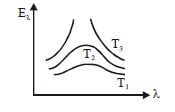
- 3View SolutionVariation of radiant energy emitted by sun, filament of tungsten lamp and welding arc as a function of its wavelength is shown in figure. Which of the following option is the correct match?
- 4View SolutionAn ideal black body at room temperature is thrown into a furnace. It is observed that
- 5Liquid is filled in a vessel which is kept in a room with temperature ${20^o}C$. When the temperature of the liquid is ${80^o}C$, then it loses heat at the rate of $60\;cal/\sec $. What will be the rate of loss of heat when the temperature of the liquid is ${40^o}C$ ....... $cal/\sec $View Solution
- 6In a certain planetary system, it is observed that one of the celestial bodies having a surface temperature of $200 \;K$, emits radiation of maximum intensity near the wavelength $12\; \mu m$. The surface temperature (in $K$) of a nearby star which emits light of maximum intensity at a wavelength $\lambda= 4800\;\mathring A$ isView Solution
- 7A body takes $5$ minutes to cool from $90^oC$ to $60^oC$. If the temperature of the surroundings is $20^oC$, the time taken by it to cool from $60^oC$ to $30^oC$ will be ...... $\min.$View Solution
- 8A body cools from ${60^o}C$ to ${50^o}C$ in $10$ minutes when kept in air at ${30^o}C$. In the next $10$ minutes its temperature will beView Solution
- 9A black body is heated from ${27^o}C$ to ${127^o}C$. The ratio of their energies of radiations emitted will beView Solution
- 10A certain stellar body has radius $50 \,R_{s}$ and temperature $2 \,T_{s}$ and is at a distance of $2 \times 10^{10} \,AU$ from the earth. Here, $AU$ refers to the earth-sun distance and $R_{s}$ and $T_{s}$ refer to the sun's radius and temperature, respectively. Take, both star and sun to be ideal black bodies. The ratio of the power received on earth from the stellar body as compared to that received from the sun is close toView Solution