MCQ
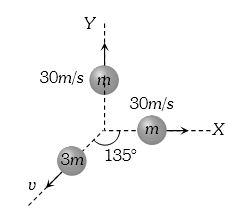
A vessel at rest explodes into three pieces. Two pieces having equal masses fly off perpendicular to one another with the same velocity $30$ meter per second. The third piece has three times mass of each of other piece. The magnitude and direction of the velocity of the third piece will be
  • $10\sqrt 2 \,m/second$ and $135°$ from either
  • B
    $10\sqrt 2 \,m/second$ and $45°$ from either
  • C
    $\frac{{10}}{{\sqrt 2 }}\,m/second$ and $135°$ from either
  • D
    $\frac{{10}}{{\sqrt 2 }}\,m/second$ and $45°$ from either
Answer

Correct option: A.
$10\sqrt 2 \,m/second$ and $135°$ from either
a
(a)Let two pieces are having equal mass m and third piece have a mass of $3m$.
According to law of conservation of linear momentum. Since the initial momentum of the system was zero, therefore final momentum of the system must be zero i.e. the resultant of momentum of two pieces must be equal to the momentum of third piece. We know that if two particle possesses same momentum and angle in between them is $90°$ then resultant will be given by $P\sqrt 2 = mv\sqrt 2 = m30\sqrt 2 $
Let the velocity of mass $3m$ is $V$. So $3mV = 30m\sqrt 2 $
 $V = 10\sqrt 2 $ and angle $135°$ from either.
(as it is clear from the figure)

Need a full question paper?

Generate a complete, print-ready paper with questions like this in minutes — across 16+ boards, with answer keys.

Start Generating Free

Similar questions

Radius of the curved road on national highway is $R$. Width of the road is $b$. The outer edge of the road is raised by $h$ with respect to inner edge so that a car with velocity $v$ can pass safe over it. The value of $h$ is
Two skaters $P$ and $Q$ are skating towards each other. Skater $P$ throws a ball towards $Q$ every $5 \,s$ such that it always leaves her hand with speed $2 \,ms ^{-1}$ with respect to the ground. Consider two cases:

$(I)$ $P$ runs with speed $1 \,ms ^{-1}$ towards $Q$, while $Q$ remains stationary.

$(II)$ $Q$ runs with speed $1 \,ms ^{-1}$ towards $P$, while $P$ remains stationary.

Note That irrespective of speed of $P$, ball always leaves $P$ s hand with speed $2 \,ms ^{-1}$ with respect to the ground. Ignore gravity. Balls will be received by $Q$.

An endoscope is employed by a physician to view the internal parts of a body organ. It is based on the principle of
A mass $M$ moving with a certain speed $V$ collides elastically with another stationary mass $m$. After the collision, the masses $M$ and $m$ move with speeds $V^{\prime}$ and $v$, respectively. All motion is in one dimension. Then,
If the radius of earth is reduced to three-fourth of its present value without change in its mass then value of duration of the day of earth will be__________.hours $30$ minutes.
The figure below shows the plot of $\frac{P V}{n T}$ versus $P$ for oxygen gas at two different temperatures.
Image
Read the following statements concerning the above curves :
(i) The dotted line corresponds to the 'ideal' gas behaviour.
(ii) $T _1> T _2$
(iii) The value of $\frac{ PV }{ nT }$ at the point where the curves meet on the $y$-axis is the same for all gases. Which of the above statement is true
$1\,kg$ of ice at $-10\,^oC$ is mixed with $4.4\, kg$ of water at $30\,^oC$. The final temperature of mixture is ........ $^oC$  (specific heat of ice is $2100\, J/kg/k$)
A photon of energy $hv$ is absorbed by a free electron of a metal having work function $\phi  < hv$
A swimmer swims in still water at a speed $= 5\,\, km/hr$. He enters a $200\,\, m$ wide river, having river flow speed $= 4\,\, km/hr$ at point A and proceeds to swim at an angle of $127^o$ (sin $37^o = 0.6$) with the river flow direction.Another point $B$ is located directly across Aon the other side. The swimmer lands on the other bank at a point $C$, from which he walks the distance $CB$ with a speed $= 3\,\, km/hr.$ The total time in which he reachrs from $A$ to $B$ is..........$minutes$
In Quincke’s tube a detector detects minimum intensity. Now one of the tube is displaced by $5 \,\,cm$. During displacement detector detects maximum intensity $10$ times, then finally a minimum intensity (when displacement is complete). The wavelength of sound is .... $cm$