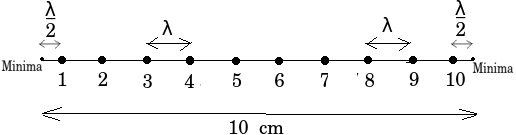
In Quincke’s tube a detector detects minimum intensity. Now one of the tube is displaced by $5 \,\,cm$. During displacement detector detects maximum intensity $10$ times, then finally a minimum intensity (when displacement is complete). The wavelength of sound is .... $cm$
Diffcult


Download our appand get started for free
Experience the future of education. Simply download our apps or reach out to us for more information. Let's shape the future of learning together!No signup needed.*
Similar Questions
- 1A wave represented by the given equation $y = a\cos (kx - \omega \,t)$ is superposed with another wave to form a stationary wave such that the point $x = 0$ is a node. The equation for the other wave isView Solution
- 2A sine wave of wavelength $\lambda $ is travelling in a medium. The minimum distance between the two particles, always having same speed, isView Solution
- 3Two engines pass each other moving in opposite directions with uniform speed of $30\,m/s$ . One of them is blowing a whistle of frequency $540\,Hz.$ Calculate the frequency heard by driver of second engine before they pass each other ... $Hz$. Speed of sound is $330\,m/sec$View Solution
- 4For a transverse wave travelling along a straight line, the distance between two peaks (crests) is $5 \,m ,$ while the distance between one crest and one trough is $1.5 \,m$ The possible wavelengths (in $m$ ) of the waves areView Solution
- 5Stationary waves are set up in air column. Velocity of sound in air is $330 m/s$ and frequency is $165\,Hz$. Then distance between the nodes is ... $m$View Solution
- 6The frequency of fundamental tone in an open organ pipe of length $0.48 m$ is $320 Hz.$ Speed of sound is $320 m/sec.$ Frequency of fundamental tone in closed organ pipe will be ... $Hz$View Solution
- 7The persistence of sound in a room after the source of sound is turned off is called reverberation. The measure of reverberation time is the time required for sound intensity to decrease by $60 \,dB$. It is given that the intensity of sound falls off as $I_0 \exp \left(-c_1 \alpha\right)$ where $I_0$ is the initial intensity, $c_1$ is a dimensionless constant with value $1 / 4$. Here, $\alpha$ is a positive constant which depends on the speed of sound, volume of the room, reverberation time, and the effective absorbing area $A_e$. The value of $A_e$ is the product of absorbing coefficient (with value between $0$ and $1,1$ being a perfect absorber) and the area of the room. For a concert hall of volume $600 \,m ^3$, the value of $A_e$ (in $m ^2$ ) required to give a reverberation time of $1 s$ is closest to (speed of sound in air $=340 \,m / s$ )View Solution
- 8A string is stretched between fixed points separated by $75.0\,\, cm.$ It is observed to have resonant frequencies of $420\,\, Hz$ and $315\,\, Hz$. There are no other resonant frequencies between these two. The lowest resonant frequency for this string is .... $Hz$View Solution
- 9The speed of sound in oxygen $\left( O _{2}\right)$ at a certain temperature is $460 \;ms ^{-1}$. The speed of sound in helium $(He)$ at the same temperature will be (asume both gases to be ideal)View Solution
- 10A wave represented by the given equation $y = a\cos (kx - \omega \,t)$ is superposed with another wave to form a stationary wave such that the point $x = 0$ is a node. The equation for the other wave isView Solution