MCQ
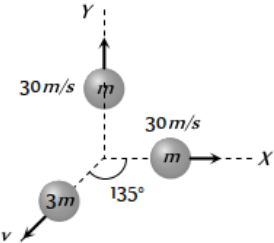
A vessel at rest explodes into three pieces. Two pieces having equal masses fly off perpendicular to one another with the same velocity 30 meter per second. The third piece has three times mass of each of other piece. The magnitude and direction of the velocity of the third piece will be
  • $10 \sqrt{2} \mathrm{~m} / \mathrm{second}$ and $135^{\circ}$ from either
  • B
    $10 \sqrt{2} \mathrm{~m} / \mathrm{second}$ and $45^{\circ}$ from either
  • C
    $\frac{10}{\sqrt{2}} \mathrm{~m} / \mathrm{second}$ and $135^{\circ}$ from either
  • D
    $\frac{10}{\sqrt{2}} \mathrm{~m} / \mathrm{second}$ and $45^{\circ}$ from either

Answer

Correct option: A.
$10 \sqrt{2} \mathrm{~m} / \mathrm{second}$ and $135^{\circ}$ from either
Let two pieces are having equal mass $m$ and third piece have a mass of $3\ m .$

According to láw of conservation of linear momentum. Since the initial momentum of the system was zero, therefore final momentum of the system must be zero i.e. the resultant of momentum of two pieces must be equal to the momentum of third piece. We know that if two particle possesses same momentum and angle in between them is $90^{\circ}$ then resultant will be given by $P \sqrt{2}=m v \sqrt{2}=m 30 \sqrt{2}$
Let the velocity of mass $3 m$ is $V$. So $3 m V=30 m \sqrt{2}$
$\therefore \quad V=10 \sqrt{2}$ and angle $135^{\circ}$ from either.
(as it is clear from the figure)

Need a full question paper?

Generate a complete, print-ready paper with questions like this in minutes — across 16+ boards, with answer keys.

Start Generating Free

Similar questions

A wave disturbance in a medium is described by $y(x, t)=0.02 \cos \left(50 \pi t+\frac{\pi}{2}\right) \cos (10 \pi x)$, where $x$ and $y$ are in metres and $t$ in seconds
For a given triode $\mu=20$. The load resistance is $1.5$ times the anode resistance. The maximum gain will be
A ball $P$ is dropped vertically and another ball $Q$ is thrown horizontally with the same velocities from the same height and at the same time. If air resistance is neglected, then
A particle of mass $m$ moving with velocity $V_0$ strikes a simple pendulum of mass $m$ and sticks to it. The maximum height attained by the pendulum will be
A wire when connected to $220 V$ mains supply has power dissipation $P_1$. Now the wire is cut into two equal pieces which are connected in parallel to the same supply. Power dissipation in this case is $P_2$. Then $P_2: P_1$ is
A boy of $50 kg$ is in a lift moving down with an acceleration $9.8 ms ^{-2}$. The apparent weight of the body is $\left(g=9.8 ms ^{-2}\right)$
The spectrum of radiation $1.0 \times 10^{14} \mathrm{~Hz}$ is in the infrared region. The energy of one photon of this in joules will be
A current carrying loop is free to turn in a uniform magnetic field. The loop will then come into equilibrium when its plane is inclined at
A person goes $10 km$ north and $20 km$ east. What will be displacement from initial point
If refractive index of red, violet and yellow lights are $1.42, 1.62$ and $1.50$ respectively for a medium. Its dispersive power will be