A viscous fluid is flowing through a cylindrical tube. The velocity distribution of the fluid is best represented by the diagram
Easy
Download our app for free and get started
(c)

Download our appand get started for free
Experience the future of education. Simply download our apps or reach out to us for more information. Let's shape the future of learning together!No signup needed.*
Similar Questions
- 1Water is flowing with a velocity of $2\,m/s$ in a horizontal pipe where cross-sectional area is $2 \times 10^{-2}\, m^2$ at pressure $4 \times 10^4\, pascal$. The pressure at cross-section of area $0.01\, m^2$ in pascal will beView Solution
- 2Acontainer of large surface area is filled with liquid of density $\rho$ .Acubical block of side edge $a$ and mass $M$ is floating in it with four-fifth of its volume submerged. If a coin of mass $m$ is placed gently on the top surface of the block is just submerged. $M$ isView Solution
- 3View SolutionIn the case of a fluid, Bernoulli's theorem expresses the application of the principle of conservation of :
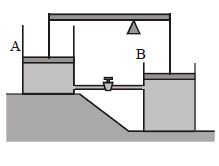
- 4In the arrangement shown both the vessels $A$ and $B$ are identical but amount of water in $B$ is double of that in $A$. The vessels are closed by identical leak proof pistons at the same height. The pistons are connected to the ends of lever arm. There is no friction between the pistons and the container walls. The system is in equilibrium in the situation shown. Now the valve in the horizontal tube connecting both the vessels is opened. In which direction will the water flow through the tube ?View Solution
- 5Water flows in a horizontal tube (see figure). The pressure of water changes by $700\; \mathrm{Nm}^{-2}$ between $\mathrm{A}$ and $\mathrm{B}$ where the area of cross section are $40\; \mathrm{cm}^{2}$ and $20\; \mathrm{cm}^{2},$ respectively. Find the rate of flow of water through the tube. ........ $\mathrm{cm}^{3} / \mathrm{s}$View Solution
(density of water $=1000\; \mathrm{kgm}^{-3}$ )

- 6A boat having a length of $3\,metre$ and breadth $2\,metre$ is floating on a lake. The boat sinks by one cm when a man gets on it. Mass of the man is ....... $kg$View Solution
- 7A barometer is constructed using a liquid (density $\left.=760 \;kg / m ^{3}\right) .$ What would be the height (In $m$) of the liquid column, when a mercury barometer reads $76 \;cm ?$ (density of mercury $\left.=13600 \;kg / m ^{3}\right)$View Solution
- 8A small sphere of mass $m$ is dropped from a great height. After it has fallen $100\; m$ , it has attained its terminal velocity and continues to fall at that speed. The work done by air friction against the sphere during the first $ 100 \;m $ of fall isView Solution
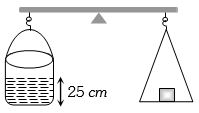
- 9A cylinder containing water up to a height of $25 cm$ has a hole of cross-section $\frac{1}{4}c{m^2}$ in its bottom. It is counterpoised in a balance. What is the initial change in the balancing weight when water begins to flow outView Solution
- 10In Guericke's experiment to show the effect of atmospheric pressure, two copper hemispheres were tightly fitted to each other to form a hollow sphere and the air from the sphere was pumped out to create vacuum inside. If the radius of each hemisphere is $R$ and the atmospheric pressure is $p$, then the minimum force required (when the two hemispheres are pulled apart by the same force) to separate the hemispheres isView Solution