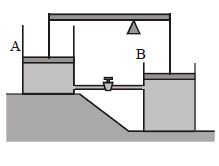
In the arrangement shown both the vessels $A$ and $B$ are identical but amount of water in $B$ is double of that in $A$. The vessels are closed by identical leak proof pistons at the same height. The pistons are connected to the ends of lever arm. There is no friction between the pistons and the container walls. The system is in equilibrium in the situation shown. Now the valve in the horizontal tube connecting both the vessels is opened. In which direction will the water flow through the tube ?
Medium


Download our appand get started for free
Experience the future of education. Simply download our apps or reach out to us for more information. Let's shape the future of learning together!No signup needed.*
Similar Questions
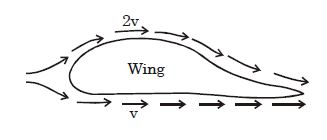
- 1The flow speeds of air on the lower and upper surfaces of the wing of an aeroplane are $v$ and $2v$ respectively. The density of air is $\rho $ and surface area of wing is $A$ . The dynamic lift on the wing isView Solution
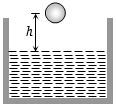
- 2A ball of radius $r $ and density $\rho$ falls freely under gravity through a distance $h$ before entering water. Velocity of ball does not change even on entering water. If viscosity of water is $\eta$, the value of $h$ is given byView Solution
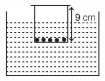
- 3A wide bottom cylindrical massless plastic container of height $9 \,cm$ has $40$ identical coins inside it and is floating on water with $3 \,cm$ inside the water. If we start putting more of such coins on its lid, it is observed that after $N$ coins are put, its equilibrium changes from stable to unstable. Equilibrium in floating is stable if the geometric centre of the submerged portion is above the centre of the mass of the object). The value of $N$ is closed toView Solution
- 4A hydraulic automobile lift is designed to lift cars with a maximum mass of $3000\, kg$. The area of cross section a of piston carrying the load is $425\, cm ^{2}$. What is the maximum pressure () would smaller piston have to bear ?View Solution
- 5A beaker is filled in with water is accelerated $a $ $m/s^2$ in $+x$ direction. The surface of water shall make on angleView Solution
- 6Suppose you have taken a dilute solution of oleic acid in such a way that its concentration becomes $0.01 \,cm ^{3}$ of oleic acid per $cm ^{3}$ of the solution. Then you make a thin film of this solution (monomolecular thickness) of area $4\, cm ^{2}$ by considering $100$ spherical drops of radius $\left(\frac{3}{40 \pi}\right)^{\frac{1}{3}} \times 10^{-3}\, cm .$ Then the thickness of oleic acid layer will be $x \times 10^{-14} \,m$. Where $x$ is ...... .View Solution
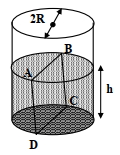
- 7Water is filled up to a height $h$ in a beaker of radius $R$ as shown in the figure. The density of water is $\rho$, the surface tension of water is $T$ and the atmospheric pressure is $P_0$. Consider a vertical section $A B C D$ of the water column through a diameter of the beaker. The force on water on one side of this section by water on the other side of this section has magnitudeView Solution
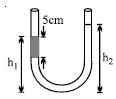
- 8An open-ended $U$-tube of uniform cross-sectional area contains water (density $1.0 $ gram/centimeter$^3$) standing initially $20$ centimeters from the bottom in each arm. An immiscible liquid of density $4.0$ grams/ centimeter $^3$ is added to one arm until a layer $5$ centimeters high forms, as shown in the figure above. What is the ratio $h_2/h_1$ of the heights of the liquid in the two arms?View Solution
- 9By sucking through a straw, a student can reduce the pressure in his lungs to $750\, mm\, of\, Hg$ (density $= 13.6\, gm/cm^3$). Using the straw, he can drink water from a glass upto a maximum depth of ....... $cm$View Solution
- 10An object falling through a fluid is observed to have acceleration given by $a = g -bv$ where $g =$ gravitational acceleration and $b$ is constant. After a long time of release, it is observed to fall with constant speed. The value of constant speed isView Solution