The strength of the magnetic field at a point $r$ near a long straight current carrying wire is $B$. The field at a distance $\frac{r}{2}$ will be
Easy
Download our app for free and get started
(c) $B \propto \frac{1}{r} \Rightarrow \frac{{{B_1}}}{{{B_2}}} = \frac{{{r_2}}}{{{r_1}}} \Rightarrow \frac{B}{{{B_2}}} = \frac{{r/2}}{r} \Rightarrow {B_2} = 2B$

Download our appand get started for free
Experience the future of education. Simply download our apps or reach out to us for more information. Let's shape the future of learning together!No signup needed.*
Similar Questions
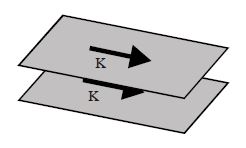
- 1View SolutionWhat are the directions of the magnetic field between and outside a pair of two parallel large sheets carrying currents in the same directions, as illustrated in Figure (from the side shown)?
- 2A uniform beam of positively charged particles is moving with a constant velocity parallel to another beam of negatively charged particles moving with the same velocity in opposite direction separated by a distance $d.$ The variation of magnetic field $B$ along a perpendicular line draw between the two beams is best represented byView Solution
- 3View SolutionThe electron in the beam of a television tube move horizontally from south to north. The vertical component of the earth's magnetic field points down. The electron is deflected towards
- 4$B _{ X }$ and $B _{ Y }$ are the magnetic field at the centre of two coils of two coils $X$ and $Y$ respectively, each carrying equal current. If coil $X$ has $200$ turns and $20 cm$ radius and coil $Y$ has $400$ turns and $20 cm$ radius, the ratio of $B _{ X }$ and $B _{ Y }$ isView Solution
- 5For a moving coil galvanometer, the deflection in the coil is $0.05\,rad$ when a current of $10\,mA$ is passed through it. If the torsional constant of suspension wire is $4.0 \times 10^{-5}\,Nm\,rad ^{-1}$, the magnetic field is $0.01\,T$ and the number of turns in the coil is $200$,the area of each turn (in $cm ^2$ ) is :View Solution
- 6If an electron revolves around a nucleus in a circular orbit of radius $R$ with frequency $n$, then the magnetic field produced at the centre of the nucleus will beView Solution
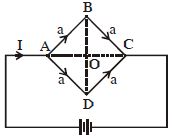
- 7Magnetic field at the centre $O$ of a square loop of side $'a'$ carrying current $I$ as shown in the figure isView Solution
- 8A loop is moulded by a constant length current carrying wire and placed in external magnetic field, then torque acts on it does not depends uponView Solution
$(a)$ Shape of loop
$(b)$ Area of loop.
$(c)$ Current in loop
$(d)$ External magnetic field.
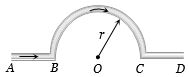
- 9the magnetic induction at $O$ due to the whole length of the conductor isView Solution
- 10A deuteron and an alpha particle having equal kinetic energy enter perpendicular into a magnetic field. Let $r_{d}$ and $r_{\alpha}$ be their respective radii of circular path. The value of $\frac{r_{d}}{r_{\alpha}}$ is equal toView Solution