An electron (charge $q$ $coulomb$) enters a magnetic field of $H$ $weber/{m^2}$ with a velocity of $v\,m/s$ in the same direction as that of the field the force on the electron is
Easy


Download our appand get started for free
Experience the future of education. Simply download our apps or reach out to us for more information. Let's shape the future of learning together!No signup needed.*
Similar Questions
- 1In figure the cube is of $40\,\, cm$ edge. Four straight segment of wire $ab, bc, cd$ and $da$ form a closed loop that carries a current $I = 5\,A$. A uniform magnetic field $0.02\,\,T$ is in $+y\,-$ direction ratio of magnetic force on segement $ab$ and $bc$ isView Solution
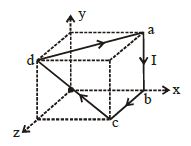
- 2A circular coil of $30$ turns and radius $8.0\, cm$ carrying a current of $6.0\, A$ is suspended vertically in a uniform horizontal magnetic field of magnitude $1.0\, T$. The field lines make an angle of $60^o$ with the normal of the coil. Calculate the magnitude of the counter torque that must be applied to prevent the coil from turning.....$Nm$View Solution
- 3If an electron revolves around a nucleus in a circular orbit of radius $R$ with frequency $n$, then the magnetic field produced at the centre of the nucleus will beView Solution
- 4Two long straight parallel wires, carrying (adjustable) current $I_1$ and $I_2$, are kept at a distance $d$ apart. If the force $'F'$ between the two wires is taken as 'positive' when the wires repel each other and 'negative' when the wires attract each other, the graph showing the dependence of $'F'$, on the product $I_1 I_2$, would beView Solution
- 5If a proton is projected in a direction perpendicular to a uniform magnetic field with velocity $v$ and an electron is projected along the lines of force, what will happen to proton and electronView Solution
- 6Two identical coils of radius $R$ and number of turns $N$ are placed perpendicular to each others in such a way that they have common centre. The current through them are $I$ and $I\sqrt 3$ . The resultant intensity of magnetic field at the centre of the coil will be (in $weber/m^2)2$View Solution
- 7A semi circular arc of radius $r$ and a straight wire along the diameter, both are carrying same current $i.$ Find out magnetic force per unit length on the small element $P$, which is at the centre of curvature.View Solution

- 8A charged particle of mass $m$ and charge $q$ travels on a circular path of radius $r$ that is perpendicular to a magnetic field $B$. The time taken by the particle to complete one revolution isView Solution
- 9$\alpha $ particle, proton and duetron enters in a uniform (transverse) magnetic field $'B'$ with same acceleration potential find ratio of radius of path followed by these particles.View Solution
- 10A current of $2\, amp$. flows in a long, straight wire of radius $2\, mm$. The intensity of magnetic field on the axis of the wire isView Solution