Question
A wall clock uses a vertical spring-mass system to measure the time. Each time the mass reaches an extreme position, the clock advances by a second. The clock gives correct time at the equator. If the clock is taken to the poles it will:
  1. Run slow.
  2. Run fast.
  3. Stop working.
  4. Give correct time.

Answer

  1. Give correct time.

Explanation:

Because the time period of a spring-mass system does not depend on the acceleration due to gravity.

Need a full question paper?

Generate a complete, print-ready paper with questions like this in minutes — across 16+ boards, with answer keys.

Start Generating Free

Similar questions

Match the column $-I$ with column $-II$ For a satellite in circular orbit,

  Column $-I$   Column $-II$
$(A)$ Kinetic energy $(p)$ $ - \frac{{G{M_E}m}}{{2r}}$
$(B)$ Potential energy $(q)$ $\sqrt {\frac{{G{M_E}}}{r}} $
$(C)$ Total energy $(r)$ $ - \frac{{G{M_E}m}}{{r}}$
$(D)$ Orbital energy $(s)$ $ \frac{{G{M_E}m}}{{2r}}$

 (where $M_E$ is the mass of the earth, $m$ is mass of the satellite and $r$ is the radius of the orbit)

Potential energy of a particle is related to $x$ coordinate by equation $x^2 - 2x$. Particle will be in stable equilibrium at
A body is sliding down an inclined plane (angle of inclination $45^o$). If the coefficient of friction is $0.5$ and $g = 9.8\, m/s^2$. then the acceleration of the body downwards in $m/s^2$ is
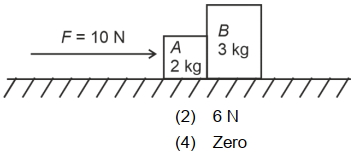
A horizontal force $10 \mathrm{~N}$ is applied to a block $A$ as shown in figure. The mass of blocks $A$ and $B$ are $2 \mathrm{~kg}$ and $3 \mathrm{~kg}$ respectively. The blocks slide over a frictionless surface. The force exerted by block $A$ on block $B$ is :
Radius of a soap bubble is increased from R to 2R. Work done in this process in terms of surface tension is:
Young's modulus of a material has the same unit as:
$STATEMENT$-$1$ A block of mass $\mathrm{m}$ starts moving on a rough horizontal surface with a velocity $\mathrm{v}$. It stops due to friction between the block and the surface after moving through a certain distance. The surface is now tilted to an angle of $30^{\circ}$ with the horizontal and the same block is made to go up on the surface with the same initial velocity $v$. The decrease in the mechanical energy in the second situation is smaller than that in the first situation. because

$STATEMENT$- $2$ The coefficient of friction between the block and the surface decreases with the increase in the angle of inclination.

A car accelerates on a horizontal road due to the forces exerted by
If a copper wire is stretched to make its radius decrease by $0.1\%$ , then percentage increase in resistance is approximately .......... $\%$
An aeroplane moving horizontally with a speed of $180\, km/hr$. drops a food packet while flying at a height of $490\,m$. The horizontal range is........$m$