A charge of $8\; mC$ is located at the origin. Calculate the work done in $J$ in taking a small charge of $-2 \times 10^{-9} \;C$ from a point $P (0,0,3\; cm )$ to a point $Q (0,4\; cm , 0),$ via a point $R (0,6\; cm , g \;cm )$
Medium
Download our app for free and get started
Charge located at the origin, $q=8 \,mC =8 \times 10^{-3} \,C$
Magnitude of a small charge, which is taken from a point $P$ to point $R$ to point $Q, \;\;q_{1}=-2 \times 10^{-9} \,C$
All the points are represented in the given figure.
Point $P$ is at a distance, $d_{1}=3 \,cm ,$ from the origin along $z$ -axis. Point $Q$ is at a distance, $d _{2}=4 \,cm ,$ from the origin along $y$ -axis.
Potential at point $P, \quad V_{1}=\frac{q}{4 \pi \epsilon_{0} \times d_{1}}$
Potential at point $Q$, $\quad V_{2}=\frac{q}{4 \pi \epsilon_{0} d_{2}}$
Work done $(W)$ by the electrostatic force is independent of the path. $\therefore W=q_{1}\left[V_{2}-V_{1}\right]$
$=q_{1}\left[\frac{q}{4 \pi \epsilon_{0} d_{2}}-\frac{q}{4 \pi \epsilon_{0} d_{1}}\right]$
$=\frac{q q_{1}}{4 \pi \epsilon_{0}}\left[\frac{1}{d_{2}}-\frac{1}{d_{1}}\right]$
Where, $\frac{1}{4 \pi \epsilon_{0}}=9 \times 10^{9} \,N\, m ^{2} \,C ^{-2}$
$\therefore W=9 \times 10^{9} \times 8 \times 10^{-3} \times\left(-2 \times 10^{-9}\right)\left[\frac{1}{0.04}-\frac{1}{0.03}\right]$
$=-144 \times 10^{-3} \times\left(\frac{-25}{3}\right)$
$=1.27 \,J$
Therefore, work done during the process is $1.27 \;J$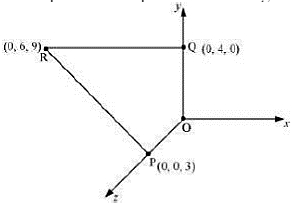

Download our appand get started for free
Experience the future of education. Simply download our apps or reach out to us for more information. Let's shape the future of learning together!No signup needed.*
Similar Questions
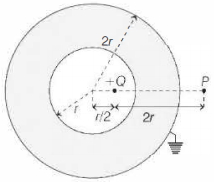
- 1Consider an initially neutral hollow conducting spherical shell with inner radius $r$ and outer radius $2 r$. A point charge $+Q$ is now placed inside the shell at a distance $r / 2$ from the centre. The shell is then grounded by connecting the outer surface to the earth. $P$ is an external point at a distance $2 r$ from the point charge $+Q$ on the line passing through the centre and the point charge $+Q$ as shown in the figure. The magnitude of the force on a test charge $+q$ placed at $P$ will beView Solution
- 2How much kinetic energy will be gained by an $\alpha - $particle in going from a point at $70\,V$ to another point at $50\,V$View Solution
- 3In a parallel plate capacitor of capacitance $C$, a metal sheet is inserted between the plates, parallel to them. If the thickness of the sheet is half of the separation between the plates. The capacitance will beView Solution
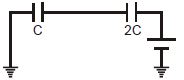
- 4In the circuit shown in figure battery is $10 \ V$ and $C = 6\,\mu F$ . The charge stored in capacitor of capacity $C$ is......$\mu C$View Solution
- 5View SolutionTwo capacitors of equal capacity are first connected in parallel and then in series. The ratio of the total capacities in the two cases will be
- 6For changing the capacitance of a given parallel plate capacitor, a dielectric material of dielectric constant $K$ is used, which has the same area as the plates of the capacitor. The thickness of the dielectric slab is $\frac{3}{4} d$, where $'d'$ is the separation between the plates of parallel plate capacitor. The new capacitance $(C')$ in terms of original capacitance $\left( C _{0}\right)$ is given by the following relationView Solution
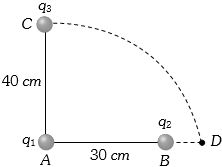
- 7Two charges ${q_1}$ and ${q_2}$ are placed $30\,\,cm$ apart, shown in the figure. A third charge ${q_3}$ is moved along the arc of a circle of radius $40\,cm$ from $C$ to $D$. The change in the potential energy of the system is $\frac{{{q_3}}}{{4\pi {\varepsilon _0}}}k$, where $k$ isView Solution
- 8How will the voltage $(V)$ between the two plates of a parallel plate capacitor depend on the distance $(d)$ between the plates, if the charge on the capacitor remains the same?View Solution
- 9A proton and an anti-proton come close to each other in vacuum such that the distance between them is $10 \,cm$. Consider the potential energy to be zero at infinity. The velocity at this distance will be ........... $\,m / s$View Solution
- 10Four point charges $-Q, -q, 2q$ and $2Q$ are placed, one at each comer of the square. The relation between $Q$ and $q$ for which the potential at the centre of the square is zero isView Solution