Question
How did de Broglie hypothesis lead to Bohr’s quantum condition of atomic orbits?

Answer

According to Bohr’s quantum condition “Only those atomic orbits are allowed as stationary orbits in which angular momentum of an electron is the integral multiple of $\frac{\text{h}}{2\pi}."$ If m is the mass, v velocity and r radius of orbit, then angular momentum of electron L = mvr. According to Bohr’s quantum condition, $\text{mvr}=\text{n}\frac{\text{h}}{2\pi}\dots(\text{i})$ According to de Broglie quantum condition only those atomic orbits are allowed as stationary orbits in which circumference of electron-orbit is the integral multiple of de Broglie wavelength associated with electron, i.e., $2\pi\text{r}=\text{n}\lambda\dots(\text{ii})$ According to de Broglie hypothesis, $\lambda=\frac{\text{h}}{\text{mv}}\dots(\text{iii})$ Substituting this value in (ii), we get $2\pi\text{r}=\text{n}\Big(\frac{\text{h}}{\text{mv}}\Big)\Rightarrow\ \text{mvr}=\text{n}\frac{\text{h}}{2\pi}$This is Bohr's quantum condition.

Need a full question paper?

Generate a complete, print-ready paper with questions like this in minutes — across 16+ boards, with answer keys.
Start Generating Free

Similar questions

Poynting vectors S is defined as a vector whose magnitude is equal to the wave intensity and whose direction is along the direction of wave propogation. Mathematically, it is given by $\text{S}=\frac{1}{\mu_0}\text{E}\times\text{B}$. Show the nature of S vs t graph.
In an intrinsic semiconductor the energy gap $E_g$ is 1.2eV. Its hole mobility is much smaller than electron mobility and independent of temperature. What is the ratio between conductivity at 600K and that at 300K? Assume that the temperature dependence of intrinsic carrier concentration $n_i$ is given by,
$\text{n}_{\text{i}}=\text{n}_{\text{0}}\ {\text{exp}}\Big(-\frac{\text{E}_\text{g}}{2{\text{K}_{\text{B}}}{\text{T}}}\Big)$
where $n_0$​​​​​​​ is a constant.
What are energy bands? How are these formed? Distinguish between a conductor, an insulator and a semiconductor on the basis of energy band diagram.
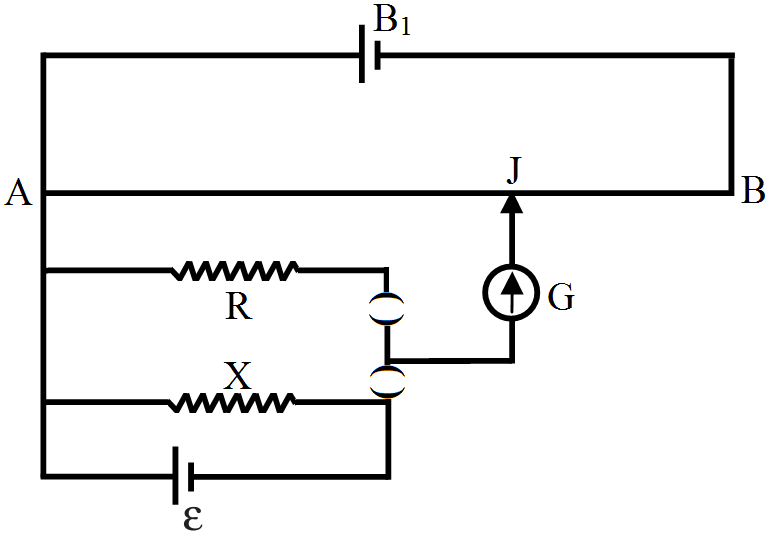
Figure shows a potentiometer circuit for comparison of two resistances. The balance point with a standard resistance $\text{R}=10.0\Omega$ is found to be 58.3cm, while that with the unknown resistance X is 68.5cm. Determine the value of X. What might you do if you failed to find a balance point with the given cell $\varepsilon.$
How many time constants will elapse before the energy stored in the capacitor reaches half of its equilibrium value in a charging RC circuit?
A radio can tune in to any station in the 7.5 MHz to 12 MHz band. What is the corresponding wavelength band?
An ornament weighing 36g in air, weighs only 34g in water. Assuming that some copper is mixed with gold to prepare the ornament, find the amount of copper in it. Specific gravity of gold is 19.3 and that of copper is 8.9.
Hari is a student of Class X in a school near his village. His uncle gifted him a bicycle with a dynamo fitted in it. He was thrilled to find that while cycling during night, he could light the bulb and see the objects on the road clearly. He, however, did not know how this device works. He asked this question to his teacher. The teacher considered it an opportunity and explained the working of a dynamo to the whole class.
Answer the following questions:
  1. State the principle and working of a dynamo.
  2. Write two values each displayed by Hari and his Science teacher.
A hydrogen atom initially in the ground level absorbs a photon, which excites it to the n = 4 level. Determine the wavelength and frequency of photon.
Prove that the value of energy stored in a capacitor is $\frac{1 Q^2}{2 C}$ and the energy density of the electric field is $u=\frac{1}{2} \epsilon_0 E ^2$.