A wave is propagating along $x$-axis. The displacement of particles of the medium in $z$-direction at $t = 0$ is given by: $z =$ exp$[ -(x + 2)^2]$ , where $‘x’$ is in meters. At $t = 1s$, the same wave disturbance is given by: $z =$ exp $ [ - (2 - x)^2 ]$. Then, the wave propagation velocity is
Advanced


Download our appand get started for free
Experience the future of education. Simply download our apps or reach out to us for more information. Let's shape the future of learning together!No signup needed.*
Similar Questions
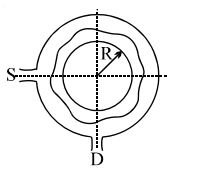
- 1A narrow tube is bent in the form of a circle of radius $R,$ as shown in the figure. Two small holes $S$ and $D$ are made in the tube at the positions right angle to each other. A source placed at $S$ generated a wave of intensity $I_0$ which is equally divided into two parts : One part travels along the longer path, while the other travels along the shorter path. Both the part waves meet at the point $D$ where a detector is placed If the minima is formed at the detector then, the magnitude of wavelength $\lambda$ of the wave produced is given byView Solution
- 2$Assertion :$ When a beetle moves along the sand within a few tens of centimeters of a sand scorpion, the scorpion immediately turns towards the beetle and dashes towards itView Solution
$Reason :$ When a beetle disturbs the sand, it sends pulses along the sand's surface. One set of pulses is longitudinal while the other set is transverse. - 3To increase the frequency from $100 Hz$ to $400 Hz$ the tension in the string has to be changed by ..... $times$View Solution
- 4The equation of progressive wave is $y = a\sin (200\,t - x)$. where $x$ is in meter and $t$ is in second. The velocity of wave is ..... $m/sec$View Solution
- 5When a guitar string is sounded with a $440\, Hz$ tuning fork, a beat frequency of $5\, Hz$ is heard. If the experiment is repeated with a tuning fork of $437\,Hz$, the beat frequency is $8\, Hz$. The string frequency $(Hz)$ isView Solution
- 6An observer is approaching with a speed $v$, towards a stationary source emitting sound waves of wavelength $\lambda_0$. The wavelength shift detected by the observer is (Take $c=$ speed of sound)View Solution
- 7A sound source is moving towards a stationary observer with $(1/10)$ of the speed of sound. The ratio of apparent to real frequency is .........View Solution
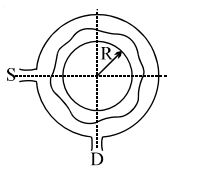
- 8A narrow tube is bent in the form of a circle of radius $R,$ as shown in the figure. Two small holes $S$ and $D$ are made in the tube at the positions right angle to each other. A source placed at $S$ generated a wave of intensity $I_0$ which is equally divided into two parts : One part travels along the longer path, while the other travels along the shorter path. Both the part waves meet at the point $D$ where a detector is placed The maximum intensity produced at $D$ is given byView Solution
- 9An organ pipe $40\,cm$ long is open at both ends. The speed of sound in air is $360\,ms ^{-1}$. The frequency of the second harmonic is $...........\,Hz$.View Solution
- 10View SolutionWhich of the following is different from others