Question
A wedge of height $H$ (fixed) and inclination $\alpha $ (variable) is moving on a smooth horizontal surface with constant acceleration $g\ m/s^2$ . A small block is placed at bottom of incline as shown in figure, slips on the smooth surface of incline . Choose $CORRECT$ statement about time taken by block to reach the top of incline
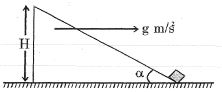
Answer

Acceleration up to incline

$a=g \cos \alpha-g \sin \alpha$

time to reach top

$\frac{\mathrm{H}}{\sin \alpha}=\frac{1}{2}(g)(\cos \alpha-\sin \alpha) \mathrm{t}^{2}$

$t^{2}=\frac{2 H}{g}=\frac{1}{\sin \alpha \cos \alpha-\cos ^{2} \alpha}$

$=\frac{4 \mathrm{H}}{\mathrm{g}} \frac{1}{\sin 2 \alpha-1+\cos ^{2} \alpha}$

$=\frac{4 \mathrm{H}}{\mathrm{g}} \frac{1}{\left(\sin 2 \alpha+\cos ^{2} \alpha\right)-1}$

so $t$ first decreases than increases.

Need a full question paper?

Generate a complete, print-ready paper with questions like this in minutes — across 16+ boards, with answer keys.

Start Generating Free

Similar questions

A neutral spherical copper particle has a radius of $10 \,nm \left(1 \,nm =10^{-9} \,m \right)$. It gets charged by applying the voltage slowly adding one electron at a time. Then, the graph of the total charge on the particle versus the applied voltage would look like
A vibrating string of certain length $\ell$ under a tension $\mathrm{T}$ resonates with a mode corresponding to the first overtone (third harmonic) of an air column of length $75 \mathrm{~cm}$ inside a tube closed at one end. The string also generates $4$ beats per second when excited along with a tuning fork of frequency $\mathrm{n}$. Now when the tension of the string is slightly increased the number of beats reduces $2$ per second. Assuming the velocity of sound in air to be $340 \mathrm{~m} / \mathrm{s}$, the frequency $\mathrm{n}$ of the tuning fork in $\mathrm{Hz}$ is
One mole of an ideal gas with $\gamma = 1.4$, is adiabatically compressed so that its temperature rises from $27°C$ to $35°C$. The change in the internal energy of the gas is ....... $J$ $(R = 8.3\,J/mol.K)$
$\mathop {(A)\,}\limits_{{C_7}{H_{14}}} \xrightarrow[{Zn}]{{{O_3}}}\left( B \right)\, + \,\left( C \right)$

Compound $(A)$ exist in geometrical isomers and $(B)$ gives cannizaro reaction $(A)$ will be

Two particles $A$ and $B$ start from rest and move for equal time on a straight line. Particle $A$ has an acceleration of $2\,m / s ^2$ for the first half of the total time and $4\,m / s ^2$ for the second half. The particle $B$ has acceleration $4\,m / s ^2$ for the first half and $2\,m / s ^2$ for the second half. Which particle has covered larger distance?
Wheatstone bridge principle is used to measure the specific resistance $\left(S_1\right)$ of given wire, having length $L$, radius $r$. If $X$ is the resistance of wire, then specific resistance is: $S_1=X\left(\frac{\pi r^2}{L}\right)$. If the length of the wire gets doubled then the value of specific resistance will be :
Inside a hollow charged spherical conductor, the potential
When radiation is incident on a photoelectron emitter, the stopping potential is found to be $9$ volts. If $e/m$ for the electron is $1.8 \times {10^{11}}\,C\,k{g^{ - 1}}$ the maximum velocity of the ejected electrons is
During capillary rise of a liquid in a capillary tube, the surface of contact that remains constant is of
A ball is dropped from a height of $20\, cm$. Ball rebounds to a height of $10\, cm$. What is the loss of energy ? ................ $\%$