A weightless spring of length $60\, cm$ and force constant $200\, N/m$ is kept straight and unstretched on a smooth horizontal table and its ends are rigidly fixed. A mass of $0.25\, kg$ is attached at the middle of the spring and is slightly displaced along the length. The time period of the oscillation of the mass is
Easy


Download our appand get started for free
Experience the future of education. Simply download our apps or reach out to us for more information. Let's shape the future of learning together!No signup needed.*
Similar Questions
- 1The phase (at a time $t$) of a particle in simple harmonic motion tellsView Solution
- 2Force constant of a spring is $K$ . If half part is detached then force constant of the remaining spring will beView Solution
- 3The function $(sin\,\omega t -cos\,\omega t)$ representsView Solution
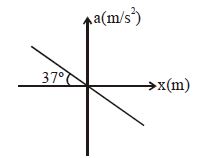
- 4The acceleration displacement graph of a particle executing $SHM$ is shown in figure. The time period of simple harmonic motion isView Solution
- 5A trolley of mass $m_1$ is placed on horizontal rigid pair of rails at same height. A mass $m_2$ is suspended to the trolley vertically by me ans of a ideal massless rope. The rope hangs between rails without touching them. Trolley can move along smooth rails but can't move in any other direction. Suspended mass is given small oscillation and perform $SHM$ after displacing small from stable equilibrium position in two ways, first perpendicular to the rails and second parallel to the rails. The ratio of time period of these (second case to first case) two $SHM's$ isView Solution
- 6A particle of mass $250\,g$ executes a simple harmonic motion under a periodic force $F =(-25\,x) N$. The particle attains a maximum speed of $4\,m / s$ during its oscillation. The amplitude of the motion is $...........cm$.View Solution
- 7Two particles P and Q describe S.H.M. of same amplitude $a$, same frequency $f$ along the same straight line. The maximum distance between the two particles is a $\sqrt{2}$.The initial phase difference between the particle is -View Solution
- 8A particle performing $SHM$ is found at its equilibrium at $t = 1\,sec$. and it is found to have a speed of $0.25\,m/s$ at $t = 2\,sec$. If the period of oscillation is $6\,sec$. Calculate amplitude of oscillationView Solution
- 9Four simple harmonic vibrations:View Solution
${y_1} = 8\,\cos\, \omega t;\,{y_2} = 4\,\cos \,\left( {\omega t + \frac{\pi }{2}} \right)$ ;
${y_3} = 2\cos \,\left( {\omega t + \pi } \right);\,{y_4} = \,\cos \,\left( {\omega t + \frac{{3\pi }}{2}} \right)$ ,
are superposed on each other. The resulting amplitude and phase are respectively;
- 10An oscillator of mass $M$ is at rest in its equilibrium position in a potential $V\, = \,\frac{1}{2}\,k{(x - X)^2}.$ A particle of mass $m$ comes from right with speed $u$ and collides completely inelastically with $M$ and sticks to it . This process repeats every time the oscillator crosses its equilibrium position .The amplitude of oscillations after $13$ collisions is: $(M = 10,\, m = 5,\, u = 1,\, k = 1 ).$View Solution