A weightless spring which has a force constant oscillates with frequency $n$ when a mass $m$ is suspended from it. The spring is cut into two equal halves and a mass $2m $ is suspended from it. The frequency of oscillation will now become
Medium
Download our app for free and get started
(a) $n = \frac{1}{{2\pi }}\sqrt {\frac{k}{m}} $
==>$\frac{n}{{n'}} = \sqrt {\frac{k}{m} \times \frac{{m'}}{{K'}}} $
$ = \sqrt {\frac{k}{m} \times \frac{{2m}}{{2K}}} = 1$
==> $n' = n$

Download our appand get started for free
Experience the future of education. Simply download our apps or reach out to us for more information. Let's shape the future of learning together!No signup needed.*
Similar Questions
- 1Amplitude of a mass-spring system, which is executing simple harmonic motion decreases with time. If mass $=500\, g$, Decay constant $=20 \,g / s$ then ...... $s$ time is required for the amplitude of the system to drop to half of its initial value ? $(\ln 2=0.693)$View Solution
- 2The amplitude of a particle executing $S.H.M.$ with frequency of $60 \,Hz$ is $0.01 \,m$. The maximum value of the acceleration of the particle isView Solution
- 3A particle in $SHM $ is described by the displacement equation $x(t) = A\cos (\omega t + \theta ).$ If the initial $(t = 0)$ position of the particle is $1 \,cm$ and its initial velocity is $\pi $cm/s, what is its amplitude? The angular frequency of the particle is $\pi {s^{ - 1}}$View Solution
- 4Equations $y = 2A \cos ^2 \omega \,t$ and $y = A (\sin \omega t + \cos \omega t )$ represent the motion of two particles.View Solution
- 5One end of a long metallic wire of length $L$ is tied to the ceiling. The other end is tied to massless spring of spring constant $K$. A mass $ m$ hangs freely from the free end of the spring. The area of cross-section and Young's modulus of the wire are $A$ and $Y$ respectively. If the mass is slightly pulled down and released, it will oscillate with a time period $T$ equal toView Solution
- 6A particle of mass $m$ moves in a one-dimensional potential energy $U(x) = -ax^2 + bx^4,$ where $'a'$ and $'b'$ are positive constants. The angular frequency of small oscillations about the minima of the potential energy is equal toView Solution
- 7A block of mass $0.1\, kg$ is connected to an elastic spring of spring constant $640\, Nm^{-1}$ and oscillates in a damping medium of damping constant $10^{-2}\, kg\,s^{-1}$ . The system dissipates its energy gradually. The time taken for its mechanical energy of vibration to drop to half of its initial value, is closest to ..... $s$View Solution
- 8A pendulum is executing simple harmonic motion and its maximum kinetic energy is $K_1$. If the length of the pendulum is doubled and it performs simple harmonic motion with the same amplitude as in the first case, its maximum kinetic energy is $K_2$ thenView Solution
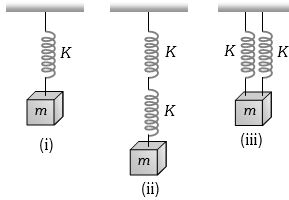
- 9View SolutionFive identical springs are used in the following three configurations. The time periods of vertical oscillations in configurations (i), (ii) and (iii) are in the ratio
- 10$Assertion :$ Resonance is a special case of forced vibration in which the natural frequency of vibration of the body is the same as the impressed frequency of external periodic force and the amplitude of forced vibration is maximum.View Solution
$Reason :$ The amplitude of forced vibrations of a body increases with an increase in the frequency of the externally impressed periodic force.