MCQ
A wheel is of diameter $1\ m.$ If it makes $30$ revolution per second, then the linear speed of a point on its circumference will be 
  • $30\,\,\pi \,\,\,m/s$
  • B
    $\pi \,\,\,m/s$
  • C
    $60\,\,\pi \,\,\,m/s$
  • D
    $\frac{\pi }{2}\,\,\,m/s$

Answer

Correct option: A.
$30\,\,\pi \,\,\,m/s$
a
$V=r \omega$

$\mathrm{V}=\frac{1}{2} \times(30 \times 2 \pi)$

$\mathrm{V}=30 \pi \mathrm{m} / \mathrm{s}$

Need a full question paper?

Generate a complete, print-ready paper with questions like this in minutes — across 16+ boards, with answer keys.
Start Generating Free

Similar questions

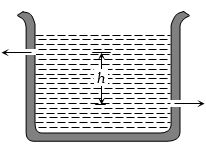
There are two identical small holes of area of cross-section a on the opposite sides of a tank containing a liquid of density $\rho $. The difference in height between the holes is $h$. Tank is resting on a smooth horizontal surface. Horizontal force which will has to be applied on the tank to keep it in equilibrium is
If the position vector of a particle is

$\vec r =  - \cos \,t\hat i + \sin \,t\hat j - 18\,t\hat k$

then what is the magnitude of its acceleration ?

The uncertain digit in the measurement of a length reported as $41.68 \,cm$ is ........... 
The potential energy of a particle of mass $m$ at a distance $r$ from a fixed point $O$ is given by $\mathrm{V}(\mathrm{r})=\mathrm{kr}^2 / 2$, where $\mathrm{k}$ is a positive constant of appropriate dimensions. This particle is moving in a circular orbit of radius $\mathrm{R}$ about the point $\mathrm{O}$. If $\mathrm{v}$ is the speed of the particle and $\mathrm{L}$ is the magnitude of its angular momentum about $\mathrm{O}$, which of the following statements is (are) true?

$(A)$ $v=\sqrt{\frac{k}{2 m}} R$

$(B)$ $v=\sqrt{\frac{k}{m}} R$

$(C)$ $\mathrm{L}=\sqrt{\mathrm{mk}} \mathrm{R}^2$

$(D)$ $\mathrm{L}=\sqrt{\frac{\mathrm{mk}}{2}} \mathrm{R}^2$

The amplitude of vibration of a particle is given by ${a_m} = ({a_0})/(a{\omega ^2} - b\omega + c);$ where ${a_0},a,b$ and $c$ are positive. The condition for a single resonant frequency is
What is the $SI$ unit of permeability
Two stones are thrown up vertically and simultaneously but with different speeds. Which graph correctly represents the time variation of their relative positions $\Delta x$.Assume that stones do not bounce after hitting ground.
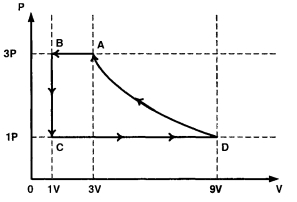
One mole of a monatomic ideal gas is taken through a cycle $ABCDA$ as shown in the $P-V$ diagram. Column $II$ gives the characteristics involved in the cycle. Match them with each of the processes qiven in Column $I$
Column $I$ Column $II$
$(A)$ Process $A \rightarrow B$ $(p)$ Internal energy decreases.
$(B)$ Process $B \rightarrow C$ $(q)$ Internal energy increases.
$(C)$ Process $C \rightarrow D$ $(r)$ Heat is lost.
$(D)$ Process $D \rightarrow A$ $(s)$ Heat is gained.
  $(t)$ Work is done on the gas.

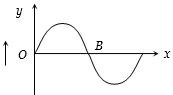
Fig. below shows the wave $y = A\sin (\omega t - kx)$ at any instant travelling in the $+ve$ $x-$direction. What is the slope of the curve at $B$
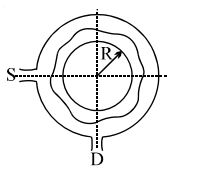
 A narrow tube is bent in the form of a circle of radius $R,$ as shown in the figure. Two small holes $S$ and $D$ are made in the tube at the positions right angle to each other. A source placed at $S$ generated a wave of intensity $I_0$ which is equally divided into two parts : One part travels along the longer path, while the other travels along the shorter path. Both the part waves meet at the point $D$ where a detector is placed If a maxima is formed at the detector then, the magnitude of wavelength $\lambda$ of the wave produced is given by $\pi R$