Question
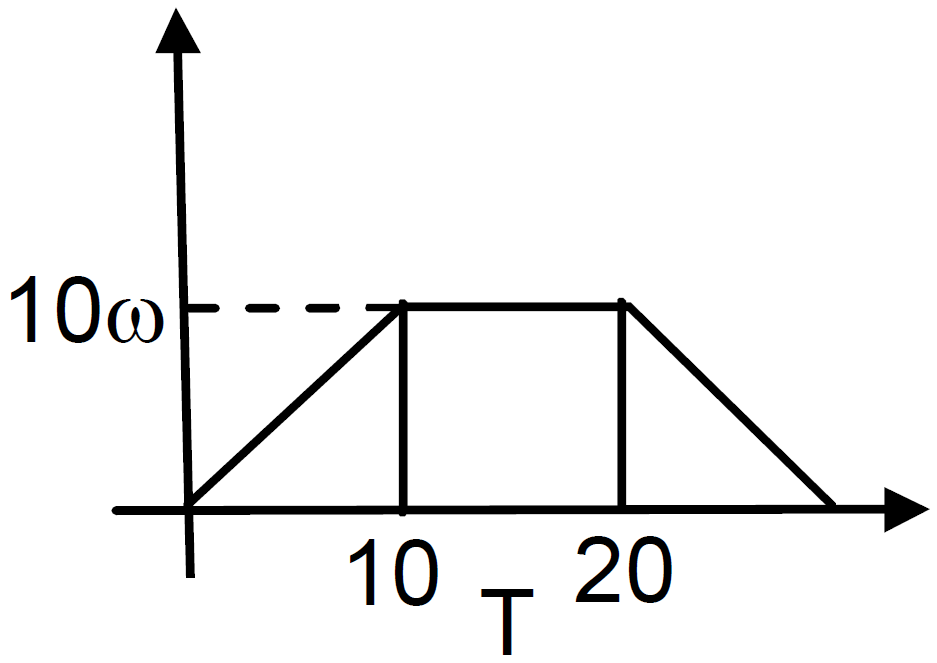
A wheel starting from rest is uniformly accelerated at 4 rad/-s2 for 10 seconds.It is allowed to rotate uniformly for the next 10 seconds and is finally brought to rest in the next 10 seconds. Find the total angle rotated by the wheel.

Answer

Area under the curve will decide the total angle rotated

$\therefore$ Maximum angular velocity = 4 × 10 = 40 rad/-s

Therefore, area under the curve $=\frac{1}2{}\times10\times40+40\times10+\frac{1}{2}\times40\times10$

$=800\text{rad}$

$\therefore$ Total angle rotated = 800rad.
Need a full question paper?

Generate a complete, print-ready paper with questions like this in minutes — across 16+ boards, with answer keys.
Start Generating Free

Similar questions

A magnetised needle in a uniform magnetic field experiences a torque but no net force. An iron nail near a bar magnet, however, experiences a force of attraction in addition to a torque. Why?
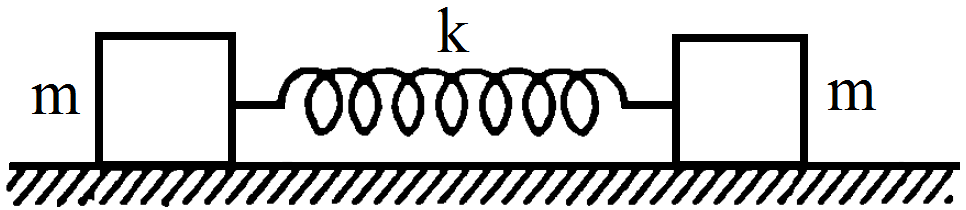
Consider the situation shown in figure Show that if the blocks are displaced slightly in opposite directions and released, they will execute simple harmonic motion. Calculate the time period.

Suppose a monochromatic X-ray beam of wavelength 100pm is sent through a Young's double slit and the interference pattern is observed on a photographic plate placed 40cm away from the slit. What should be the separation between the slits so that the successive maxima on the screen are separated by a distance of 0.1mm?
When 1.0 × 10¹² electrons are transferred from one conductor to another, a potential difference of 10V appears between the conductors. Calculate the capacitance of the two-conductor system.
In an accelerator experiment on high-energy collisions of electrons with positrons, a certain event is interpreted as annihilation of an electron-positron pair of total energy 10.2 BeV into two γ-rays of equal energy. What is the wavelength associated with each γ-ray? (1BeV = 109 eV).
A magnetic field of strength 1.0T is produced by a strong electromagnet in a cylindrical region of radius 4.0cm, as shown in the figure. A wire, carrying a current of 2.0A, is placed perpendicular to and intersecting the axis of the cylindrical region. Find the magnitude of the force acting on the wire.

Prove that, if an insulated, uncharged conductor is placed near a charged conductor and no other conductors are present, the uncharged body must be intermediate in potential between that of the charged body and that of infinity.
Answer the following questions.

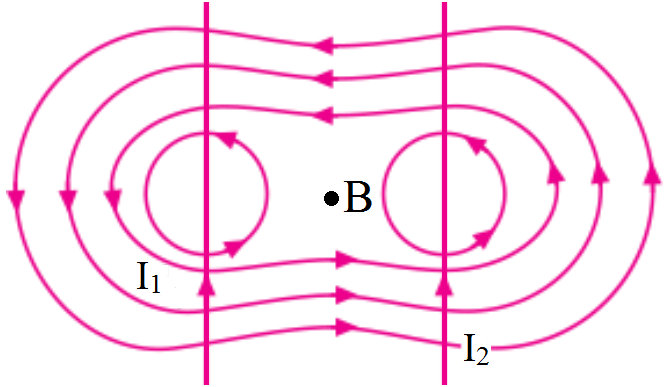
  1. Draw the magnetic field lines due to two straight, long, parallel conductors carrying currents I1 and I2 in the same direction. Write an expression for the force acting per unit length on one conductor due to other. Is this force attractive or repulsive?

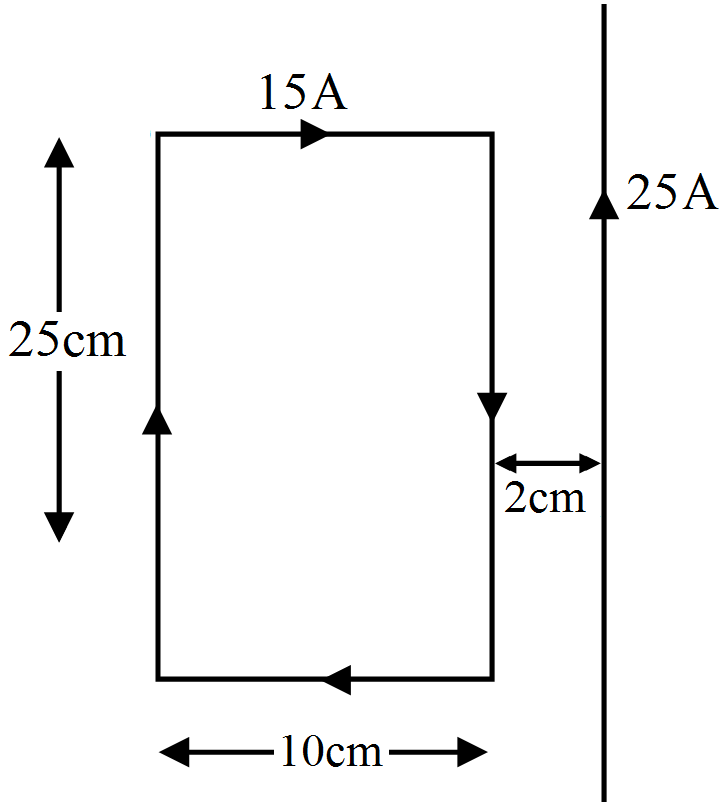
  1. Figure shows a rectangular current-carrying loop placed 2cm away from a long, straight, current-carrying conductor. What is the direction and magnitude of the net force acting on the loop?

(a) For what Kinetic energy of a neutron, will the associated de-Broglie wavelength be $1.40 \times 10^{-10} m$ ?
(b) Find the de-Broglie wavelength of a neutron, in thermal equilibrium with matter, having an average Kinetic energy of $\frac{3}{2} K_{ a } T$ at 300 K . $\left[ K _{ B }=1.38 \times 10^{-23}\right.$ SI unit $]$
How does an unpolarised light get polarised when passed through a polaroid?
Two polaroids are set in crossed positions. A third polaroid is placed between the two making an angle θ with the pass axis of the first polaroid. Write the expression for the intensity of light transmitted from the second polaroid. In what orientations will the transmitted intensity be (i) minimum and (ii) maximum?