Question
Establish a relationship between electric current and drift velocity. Draw the direction of electron flowing in a circuit by drawing an electric circuit.

Answer

SELF

Need a full question paper?

Generate a complete, print-ready paper with questions like this in minutes — across 16+ boards, with answer keys.
Start Generating Free

Similar questions

  1. Derive the expression for the torque acting on a current carrying loop placed in a magnetic field.
  2. Explain the significance of a radial magnetic field when a current carrying coil is kept in it.
Write Gauss's law and explain.
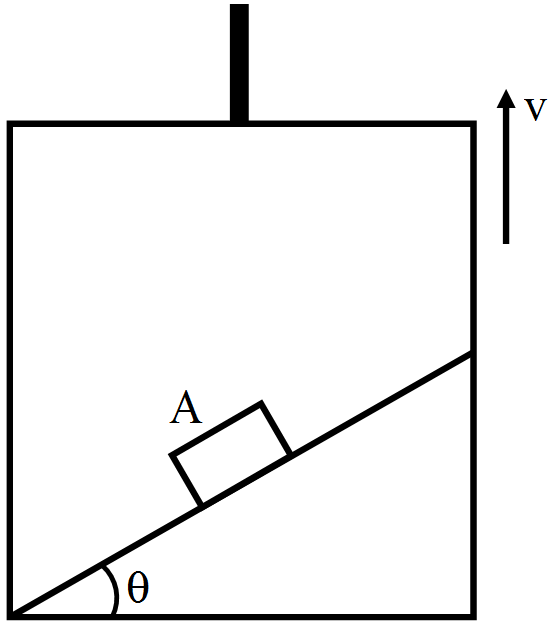
A block A can slide on a frictionless incline of angle $\theta$ and length l, kept inside an elevator going up with uniform velocity v. Find the time taken by the block to slide down the length of the incline if it is released from the top of the incline.
Write the definition of wavefront. Using Huygens' principle, draw the shape of a plane wave incident on a convex lens and the refracted wave body.
###
(a) When a wave propagates from a rarer medium to a denser medium, then which characteristic of that wave does not change and why?
(b) The refractive indices of two mediums are $\mu_1$ and $\mu_2$, what will be the ratio of velocities in the wave in them?

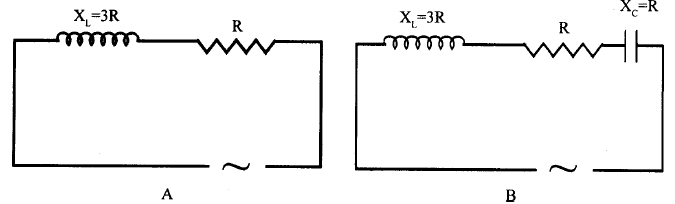
Given below are two electric circuits A and B.

Calculate the ratio of power factor of the circuit B to the power factor of circuit A.
  1. Show, with the help of a diagram, how unpolarised sunlight gets polarised due to scattering.
  2. Two polaroids $P_1$ and $P_2$ are placed with their pass axes perpendicular to each other. Unpolarised light of intensity $I_0$ is incident on $P_1$. A third polaroid $P_3$ is kept in between $P_1$ and $P_2$ such that its pass axis makes an angle of $45^{\circ}$ with that of P 1 . Determine the intensity of light transmitted through $\mathrm{P}_1, \mathrm{P}_2$ and $\mathrm{P}_3$.
Obtain expression $\vec{J}=\sigma \vec{E}$ of Ohm's law on the basis of drift velocity.
Find the energy, the frequency and the momentum of an X-ray photon of wavelength 0.10nm.
In defining the ideal gas temperature scale, it is assumed that the pressure of the gas at constant volume is proportional to the temperature T. How can we verify whether this is true or not? Are we using the kinetic theory of gases? Are we using the experimental result that the pressure is proportional to temperature?
Explain linear density, surface density and volume density for continuous charge distribution.