Question
(a) When a telescope is turned upside down and looked at the objective, it appears very small, why?
(b) Why does this not happen in a microscope?

Answer

(a) In a telescope, the focal length $\left(f_o\right)$ of the objective lens is much more than the focal length $\left(f_e\right)$ of the eyepiece and its magnification power is $f_o / f_e$. On looking back, the magnification power will become $f_e / f_o$, because $f_o \ll f_e$ hence now the object will appear very small.
(b) The formula for the magnifying power of a compound microscope is $\frac{v_o}{u_o} \times \frac{ D }{f_e}$, because the value of $v _0$ is only slightly more than the focal length $f_o$ of the objective of the microscope, hence the magnification can be considered as $\frac{v_o}{f_o} \times \frac{ D }{f_e}$; because $f_o$ and $f_e$ both have low values. Therefore, even after turning the microscope, the magnification power remains almost unchanged due to there being no significant difference in the value of $v_0$.

Need a full question paper?

Generate a complete, print-ready paper with questions like this in minutes — across 16+ boards, with answer keys.
Start Generating Free

Similar questions

Sketch a graph between frequency of incident radiations and stopping potential for a given photosensitive material. What information can be obtained from the value of the intercept on the potential axis? A source of light of frequency greater than the threshold frequency is placed at a distance of 1 m from the cathode of a photo-cell. The stopping potential is found to be V. If the distance of the light source from the cathode is reduced, explain giving reasons, what change will you observe in the.
  1. photoelectric current,
  2. stopping potential.
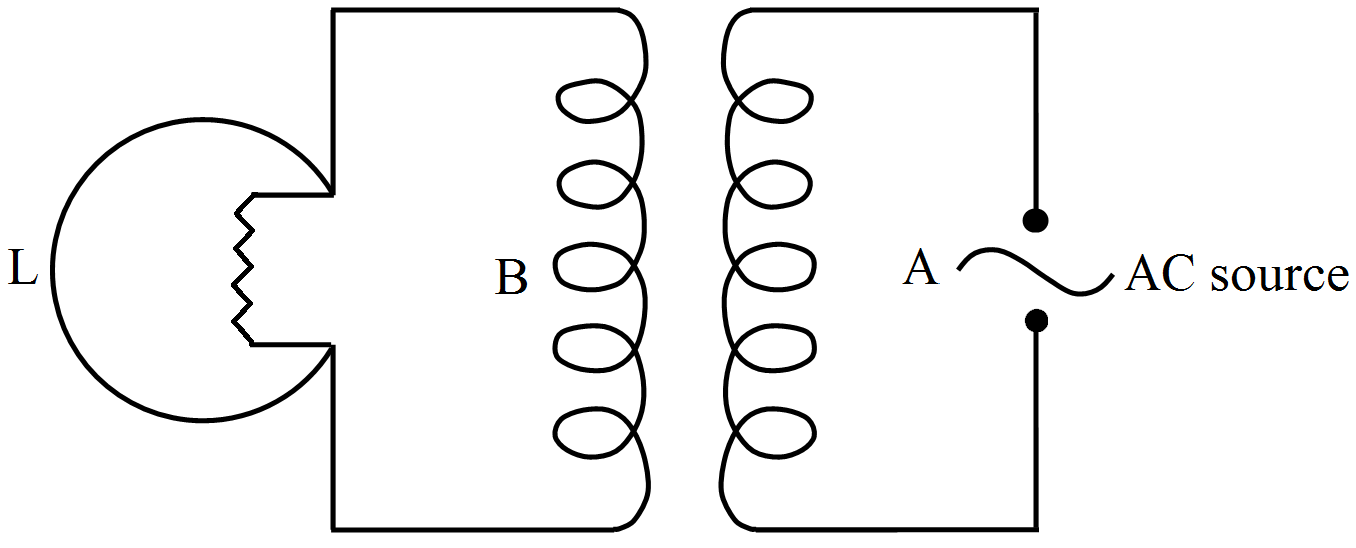
In the given diagram, a coil B is connected to low voltage bulb L and placed parallel to another coil A as shown. Explain the following observations:
  1. Bulb lights.
  2. Bulb gets dimmer if the coil B moves upwards.
State the underlying principle of a cyclotron. Explain its working with the help of a schematic diagram. Obtain the expression for cyclotron frequency.
How much energy is released in the following reaction$?$
$\text{ }^7\text{Li + p}\rightarrow\alpha+\alpha.$
Atomic mass of $^7Li = 7.0160u$ and that of $^4He = 4.0026u.$
An electron and a positron moving at small speeds collide and annihilate each other. Find the energy of the resulting gamma photon.
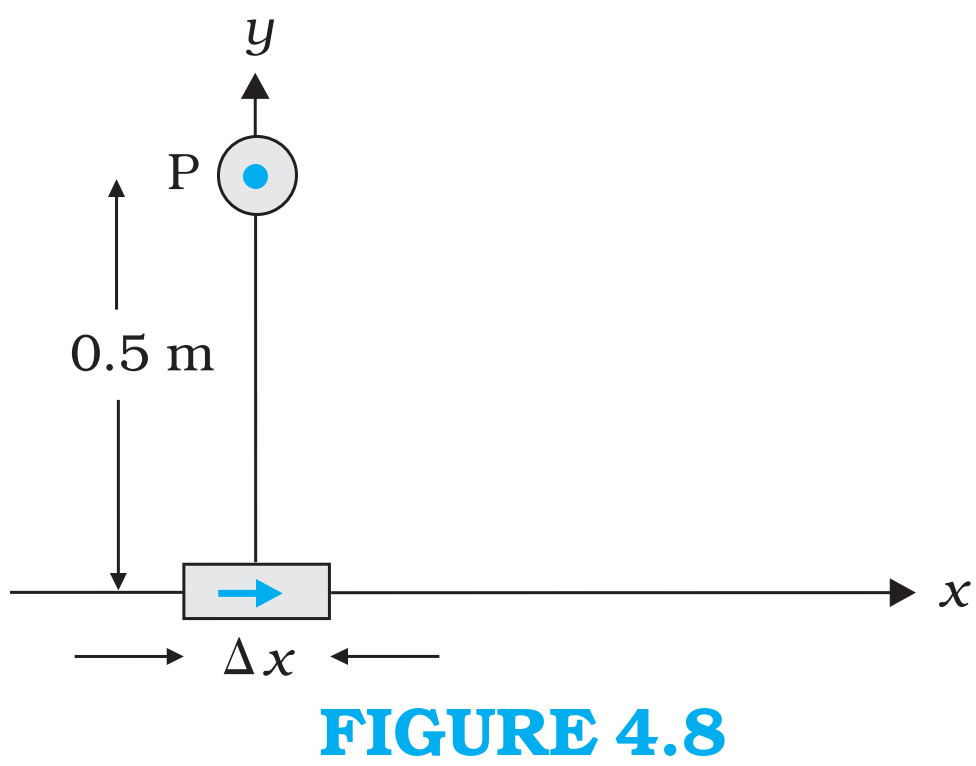
An element $\Delta l =\Delta x \hat{ i }$ is placed at the origin and carries a large current $I=10 A \ ($Fig. $4.8).$ What is the magnetic field on the $y$ axis at a distance of $0.5 m . \Delta x=1 \ cm$.
Image
In Young’s double slit experiment, the two slits $0.15 \ mm$ apart are illuminated by monochromatic light of wavelength $450 \ nm$. The screen is $1.0 m$ away from the slits.
  1. Find the distance of the second $(i)$ bright fringe, $(ii)$ dark fringe from the central maximum.
  2. How will the fringe pattern change if the screen is moved away from the slits?
Obtain the relationship between object distance $(u),$ image distance $(v)$ and focal length $(f)$ for a concave mirror. Obtain $\frac{1}{f}=\frac{1}{v}+\frac{1}{u}$ formula for a concave mirror.
A plate of area $10\ cm^2$ is to be electroplated with copper $($density $9000\ kg/m^3)$ to a thickness of $10$ micrometres on both sides, using a cell of $12V$. Calculate the energy spent by the cell in the process of deposition. If this energy is used to heat $100g$ of water, calculate the rise in the temperature of the water. $\ce{ECE}$ of copper $= 3 \times 10^{-7}kg C^1 $ and specific heat capacity of water $= 4200Jkg^1.$
An object P is focused by a microscope M. A glass slab of thickness 2.1cm is introduced between P and M. If the refractive index of the slab is 1.5, by what distance should the microscope be shifted to focus the object again?