A plate of area $10\ cm^2$ is to be electroplated with copper $($density $9000\ kg/m^3)$ to a thickness of $10$ micrometres on both sides, using a cell of $12V$. Calculate the energy spent by the cell in the process of deposition. If this energy is used to heat $100g$ of water, calculate the rise in the temperature of the water. $\ce{ECE}$ of copper $= 3 \times 10^{-7}kg C^1 $ and specific heat capacity of water $= 4200Jkg^1.$
Download our app for free and get started
Surface area of the plate $, A = 10 \ cm^2 = 10 \times 10^{-4}m^2$
Thickness of copper deposited, $\text{t}=10\mu\text{m}=10^{-5}\text{m}$ Density of copper $= 9000 \ kg/m^3$ Volume of copper deposited $, V = A(2t) V = 10 \times 10^4 \times 2 \times 10 \times 10^6 = 2 \times 10^2 \times 10^{10} = 2 \times 10^8m^3$ Mass of copper deposited $, m = \text{Volume $\times$ Density} = 2 \times 10^{−8} \times 9000$
$ \Rightarrow m = 18 \times 10^5\ kg$ Using the formula $, m = ZQ,$
We get $, 18 \times 10^5\ kg = 3 \times 10^{7 }\times Q$
$\Rightarrow Q = 6 \times 10^2C$
Energy spent by the cell $=$ Work done by the cell
$\Rightarrow W = VQ$
$= 2 \times 6 \times 10^2$
$= 72 \times 10^2 = 7.2 kJ$
Let $\Delta\theta$ be the rise in temperature of water.
When this energy is used to heat $100g$ of water,
We have,
$72 \times 10^3$
$= 100 \times 10^{-3 }\times4200\times\Delta\theta$
$\Rightarrow\Delta\theta=17\text{K}$
Thickness of copper deposited, $\text{t}=10\mu\text{m}=10^{-5}\text{m}$ Density of copper $= 9000 \ kg/m^3$ Volume of copper deposited $, V = A(2t) V = 10 \times 10^4 \times 2 \times 10 \times 10^6 = 2 \times 10^2 \times 10^{10} = 2 \times 10^8m^3$ Mass of copper deposited $, m = \text{Volume $\times$ Density} = 2 \times 10^{−8} \times 9000$
$ \Rightarrow m = 18 \times 10^5\ kg$ Using the formula $, m = ZQ,$
We get $, 18 \times 10^5\ kg = 3 \times 10^{7 }\times Q$
$\Rightarrow Q = 6 \times 10^2C$
Energy spent by the cell $=$ Work done by the cell
$\Rightarrow W = VQ$
$= 2 \times 6 \times 10^2$
$= 72 \times 10^2 = 7.2 kJ$
Let $\Delta\theta$ be the rise in temperature of water.
When this energy is used to heat $100g$ of water,
We have,
$72 \times 10^3$
$= 100 \times 10^{-3 }\times4200\times\Delta\theta$
$\Rightarrow\Delta\theta=17\text{K}$

Download our appand get started for free
Experience the future of education. Simply download our apps or reach out to us for more information. Let's shape the future of learning together!No signup needed.*
Similar Questions
- 1View SolutionDo all the thermocouples have a neutral temperature?
- 2View SolutionA voltage of 30V is applied across a carbon resistor with first, second and third rings of blue, black and yellow colours respectively. Calculate the value of current in mA, through the resistor.
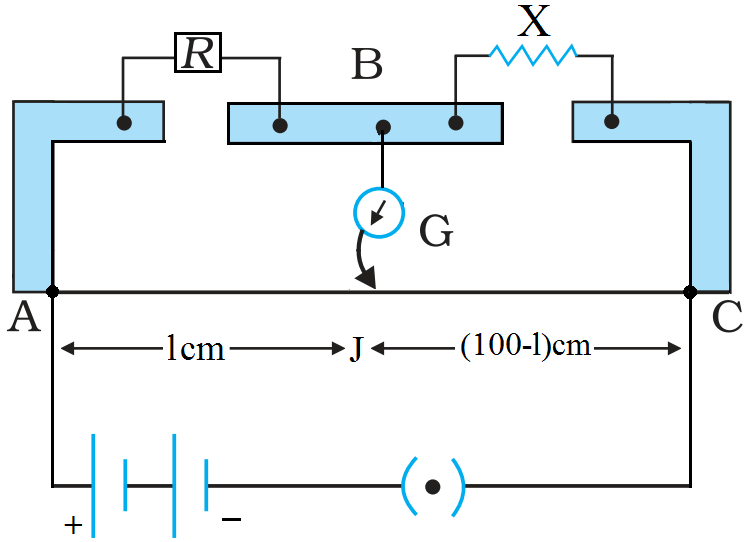
- 3A resistance $\text{R}=4\Omega$ is connected to one of the gaps in a meter bridge, which uses a wire of length 1m. An unknown resistance $\text{x}>4\Omega$ is connected in the other gap as shown in the figure. The balance point is noticed at ‘l’ cm from the positive end of the battery. On interchanging R and X, it is found that the balance point further shifts by 20cm (away from the end A). Neglecting the end correction calculate the value of unknown resistance ‘X’ used.View Solution
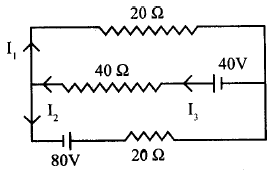
- 4View SolutionState Kirchhoff's rules of current distribution in an electrical network. Using these rules determine the value of the current I1 in the electric circuit given below.
- 5n-identical cells, each of emf $\varepsilon,$ internal resistance r connected in series are charged by a dc source of emf $\varepsilon'$ using a resistance R.View Solution
- Draw the circuit arrangement.
- Deduce expressions for (a) the charging current and (b) the potential difference across the combination of cells.
- 6A storage battery of emf $8.0 V$ and internal resistance $0.5\ \Omega$ is being charged by a $120 V\ dc$ supply using a series resistor of $15.5\ \Omega.$ What is the terminal voltage of the battery during charging? What is the purpose of having a series resistor in the charging circuit?View Solution
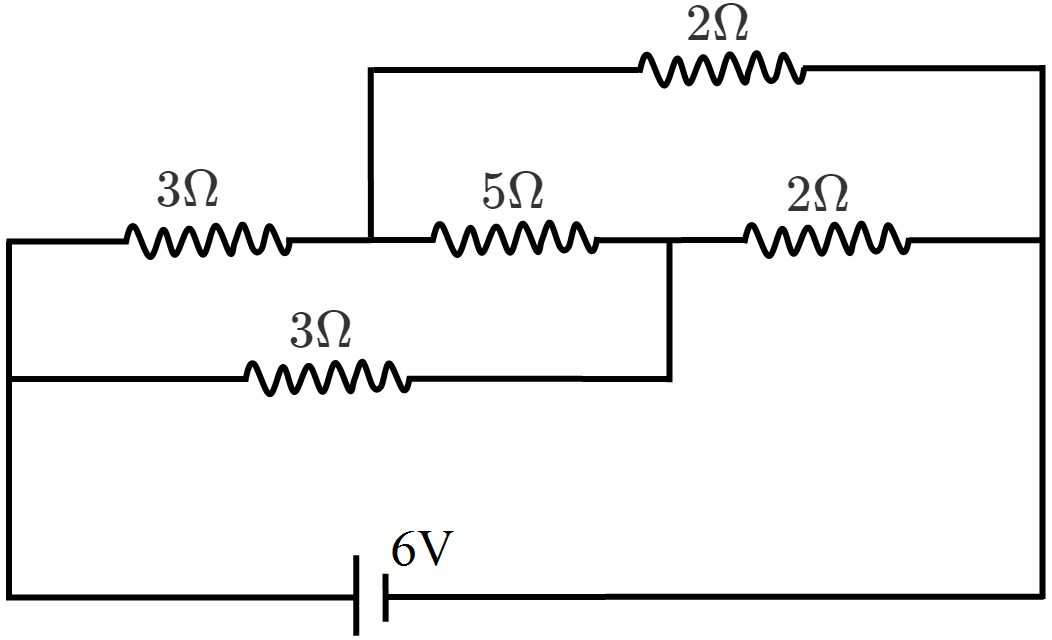
- 7View SolutionCalculate the current drawn from the battery in the given network shown here. State Kirchhoff’s loop law and name the law on which it is based.
- 8View SolutionWhat is the advantage of using thick metallic strips to join wires in a potentiometer?
- 9A coil of resistance $100\Omega$ is connected across a battery of emf $6.0V.$ Assume that the heat developed in the coil is used to raise its temperature. If the heat capacity of the coil is $4.0J/K,$ how long will it take to raise the temperature of the coil by $15^\circ C$?View Solution
- 10A uniform wire of resistance $100\Omega$ is melted and recast as a wire of length is double that of the original. What would be the resistance of the wire?View Solution