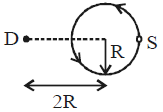
A whistle $S$ of frequency $f$ revolves in a circle of radius $R$ at a constant speed $v$. What is the ratio of largest and smallest frequency detected by a detector $D$ at rest at a distance $2R$ from the centre of circle as shown in figure ? (take $c$ as speed of sound)
Medium
Download our app for free and get started
Largest frequency will be detected when the source approaches detector along the line joining and the smallest frequency will be detected when the source recedes the detector along the line joining them
$\frac{f_{1}}{f_{2}}=\frac{\left(\frac{c}{c-v}\right) f}{\left(\frac{c}{c+v}\right) f}=\frac{c+v}{c-v}$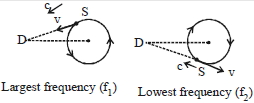

Download our appand get started for free
Experience the future of education. Simply download our apps or reach out to us for more information. Let's shape the future of learning together!No signup needed.*
Similar Questions
- 1A source of sound $S$ is moving with the velocity of $50\,m/s$ towards a stationary observer. The observer measures the frequency of the sound as $1000\,Hz.$ What will be the apparent frequency of the source when it is moving away from the observer after crossing him ... $Hz$ ? (Take velocity of sound in air is $350\,m/s$ )View Solution
- 2$Assertion :$ When a beetle moves along the sand within a few tens of centimeters of a sand scorpion, the scorpion immediately turns towards the beetle and dashes towards itView Solution
$Reason :$ When a beetle disturbs the sand, it sends pulses along the sand's surface. One set of pulses is longitudinal while the other set is transverse. - 3The intensity of sound after passing through a slab decreases by $30\%$. On passing through two such slabs, the intensity will decrease by ..... $\%$View Solution
- 4Two engines pass each other moving in opposite directions with uniform speed of $30\,m/s$ . One of them is blowing a whistle of frequency $540\,Hz.$ Calculate the frequency heard by driver of second engine before they pass each other ... $Hz$. Speed of sound is $330\,m/sec$View Solution
- 5The equation of a stationary wave is $y = 0.8\cos \,\left( {\frac{{\pi x}}{{20}}} \right)\sin 200\,\pi t$, where $x$ is in $cm$ and $t$ is in sec. The separation between consecutive nodes will be..... $cm$View Solution
- 6View SolutionWhat is the phase difference between the displacement wave and pressure wave in sound wave?
- 7A tuning fork vibrating with a sonometer having a wire of length $20 \,cm$ produces $5$ beats per second. The beats frequency does not change if the length of the wire is changed to $21 \,cm$. The frequency of the tuning fork must be ............ $Hz$View Solution
- 8If the density of oxygen is $16$ times that of hydrogen, what will be the ratio of their corresponding velocities of sound wavesView Solution
- 9A transverse wave is represented by the equation $y = {y_0}\sin \frac{{2\pi }}{\lambda }(vt - x)$ For what value of $\lambda$, the maximum particle velocity equal to two times the wave velocityView Solution
- 10Source and observer both start moving simultaneously from origin, one along $x-$axis and the other along $y-$axis with speed of source = twice the speed of observer. The graph between the apparent frequency observed by observer $f$ and time $t$ would approximately be :View Solution