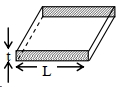
A wire has a resistance of $6 \,\Omega$. It is cut into two parts and both half values are connected in parallel. The new resistance is ................ $\Omega$
Medium


Download our appand get started for free
Experience the future of education. Simply download our apps or reach out to us for more information. Let's shape the future of learning together!No signup needed.*
Similar Questions
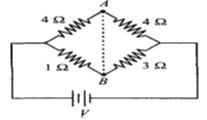
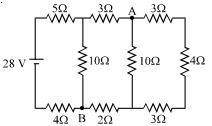
- 1In the circuit shown, if a conducting wire is connected between points $A$ and $B,$ the current in this wire willView Solution
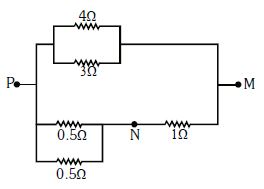
- 2In the circuit shown, the current through the $4\,\Omega $ resistor is $1\, amp$ when the points $P$ and $M$ are connected to a d.c. voltage source. The potential difference between the points $M$ and $N$ is ............... $volt$View Solution
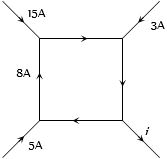
- 3The figure shows a network of currents. The magnitude of currents is shown here. The current $i$ will be ................. $A$View Solution
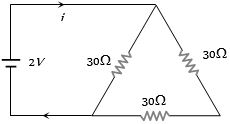
- 4View SolutionThe current in the adjoining circuit will be
- 5The specific resistance of a wire is $\rho $, its volume is $3\,{m^3}$ and its resistance is $3\, ohms$, then its length will beView Solution
- 6There is a current of $40$ ampere in a wire of ${10^{ - 6}}\,{m^2}$ area of cross-section. If the number of free electron per ${m^3}$ is ${10^{29}}$, then the drift velocity will beView Solution
- 7In Wheatstone's bridge $P = 9\, ohm$, $Q = 11\, ohm$, $R = 4\,ohm$ and $S = 6\,ohm$. How much resistance must be put in parallel to the resistance $S$ to balance the bridge ............... $ohm$View Solution
- 8The resistances of the four arms $P, Q, R$ and $S$ in a Wheatstone's bridge are $10\,ohm$, $30\,ohm$, $30\,ohm$ and $90\,ohm$, respectively. The e.m.f. and internal resistance of the cell are $7\,volt$ and $5\,ohm$ respectively. If the galvanometer resistance is $50\,ohm$, the current drawn from the cell will be ............... $A$View Solution
- 9View SolutionConsider the circuit shown in the figure
- 10Consider a thin square sheet of side $\mathrm{L}$ and thickness $\mathrm{t}$, made of a material of resistivity $\rho$. The resistance between two opposite faces, shown by the shaded areas in the figure isView Solution