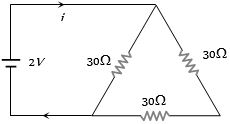
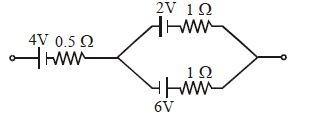
The current in the adjoining circuit will be
IIT 1983, Medium
Download our app for free and get started
(c) ${R_{{\rm{equivalent}}}} = \frac{{(30 + 30)30}}{{(30 + 30) + 30}} = \frac{{60 \times 30}}{{90}} = 20\,\Omega $
$\therefore i = \frac{V}{R} = \frac{2}{{20}} = \frac{1}{{10}}\,ampere$

Download our appand get started for free
Experience the future of education. Simply download our apps or reach out to us for more information. Let's shape the future of learning together!No signup needed.*
Similar Questions
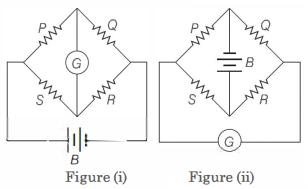
- 1Figure $(i)$ below shows a Wheatstone's bridge in which $P, Q, R$ and $S$ are fixed resistances, $G$ is a galvanometer and $B$ is a battery. For this particular case, the galvanometer shows zero deflection. Now, only the positions of $B$ and $G$ are interchanged, as shown in figure $(ii)$. The new deflection of the galvanometerView Solution
- 2View SolutionIn a metallic conductor, under the effect of applied electric field, the free electrons of the conductor
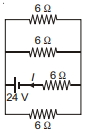
- 3Current $I$ in the network shown in figure is .......... $A$View Solution
- 4In a meter bridge experiment null point is obtained at $20\, cm$ from one end of the wire when resistance $X$ is balanced against another resistance $Y$. If $X < Y$, then where will be the new position of the null point from the same end, if one decides to balance a resistance of $4X$ against $Y$ ........... $cm$View Solution
- 5A battery of $6\, volts$ is connected to the terminals of a three meter long wire of uniform thickness and resistance of the order of $100\,\Omega $. The difference of potential between two points separated by $50\,cm$ on the wire will be .......... $V$View Solution
- 6View SolutionThe positive temperature coefficient of resistance is for
- 7$n$ equal resistors are first connected in series and then connected in parallel. What is the ratio of the maximum to the minimum resistanceView Solution
- 8Find the net emf of the three batteries shown in figure ................ $\mathrm{V}$View Solution
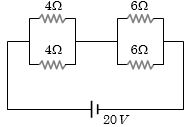
- 9Four resistances are connected in a circuit in the given figure. The electric current flowing through $4\, ohm$ and $6\, ohm$ resistance is respectivelyView Solution
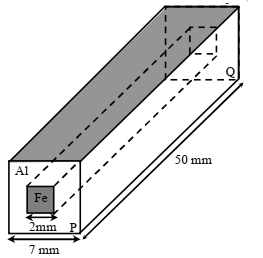
- 10In an aluminium $(A1)$ bar of square cross section, a square hole is drilled and is filled with iron ( $Fe$ ) as shown in the figure. The electrical resistivities of $A 1$ and $Fe$ are $2.7 \times 10^{-8} \ \Omega m$ and $1.0 \times 10^{-7} \ \Omega m$, respectively. The electrical resistance between the two faces $P$ and $Q$ of the composite bar isView Solution