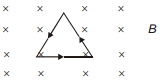
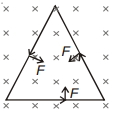
A wire is bent in the form of an equilateral triangle of side $100 \,cm$ and carries a current of $2 \,A$. It is placed in a magnetic field of induction $2.0 \,T$ directed perpendicular into the plane of paper. The direction and magnitude of magnetic force acting on each side of the triangle will be
Medium


Download our appand get started for free
Experience the future of education. Simply download our apps or reach out to us for more information. Let's shape the future of learning together!No signup needed.*
Similar Questions
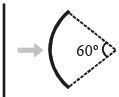
- 1A magnetised wire of moment $M$ is bent into an arc of a circle subtending an angle of $60^o$ at the centre; then the new magnetic moment isView Solution
- 2The electric current in a circular coil of four turns produces a magnetic induction $32\,T$ at its centre. The coil is unwound and is rewound into a circular coil of single turn, the magnetic induction at the centre of the coil by the same current will be $..........\,T$View Solution
- 3Two protons move parallel to each other, keeping distance $r$ between them, both moving with same velocity $\vec V\,$. Then the ratio of the electric and magnetic force of interaction between them isView Solution
- 4A moving coil galvanometer has $48$ $turns$ and area of coil is $4 \times {10^{ - 2}}\,{m^2}.$ If the magnetic field is $0.2\, T$, then to increase the current sensitivity by $25\%$ without changing area $(A)$ and field $(B)$ the number of turns should becomeView Solution
- 5A galvanometer having a coil resistance of $30\,\Omega $ shows full scale deflection when a current of $2\,A$ passes through it. It can be converted into an ammeter to read currents upto $10\,A$ byView Solution
- 6A long straight wire of radius a carries a steady current $i$. The current is uniformly distributed across its cross section. The ratio of the magnetic field at $ a/2$ and $2a$ isView Solution
- 7The earth's magnetic induction at a certain point is $7 \times {10^{ - 5}}\,Wb/{m^2}.$ This is to be annulled by the magnetic induction at the centre of a circular conducting loop of radius $5 \,cm$. The required current in the loop is......$A$View Solution
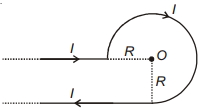
- 8Magnetic field at the centre $O$ due to the given structure isView Solution
- 9Assertion : A proton and an alpha particle having the same kinetic energy are moving in circular paths in a uniform magnetic field. The radii of their circular paths will be equal.View Solution
Reason : Any two charged particles having equal kinetic energies and entering a region of uniform magnetic field $\overrightarrow B $ in a direction perpendicular to $\overrightarrow B $, will describe circular trajectories of equal radii.
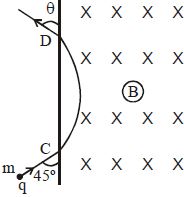
- 10A particle of mass $m = 1.67 \times 10^{-27}\, kg$ and charge $q = 1.6 \times 10^{-19} \, C$ enters a region of uniform magnetic field of strength $1$ $tesla$ along the direction shown in the figure. The speed of the particle is $10^7\, m/s.$ The magnetic field is directed along the inward normal to the plane of the paper. The particle enters the field at $C$ and leaves at $D.$ Then the angle $\theta$ must be :-.........$^o$View Solution