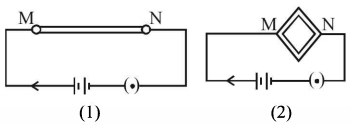
A wire is connected to a battery between the point $M$ and $N$ as shown in the figure $(1)$. The same wire is bent in the form of a square and then connected to the battery between the points $M$ and $N$ as shown in the figure $(2)$. Which of the following quantities increases?
Medium


Download our appand get started for free
Experience the future of education. Simply download our apps or reach out to us for more information. Let's shape the future of learning together!No signup needed.*
Similar Questions
- 1The resistance of the series combination of two resistance is $S$. When they are joined in parallel the total resistance is $P$. If $S = nP$, then the minimum possible value of $n$ isView Solution
- 2A cell of e.m.f. $E$ is connected with an external resistance $R$, then p.d. across cell is $V$. The internal resistance of cell will beView Solution
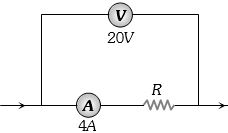
- 3In the diagram shown, the reading of voltmeter is $20\, V$ and that of ammeter is $4\, A$. The value of $R$ should be (Consider given ammeter and voltmeter are not ideal)View Solution
- 4Drift speed of electrons, when $1.5\, A$ of current flows in a copper wire of cross section $5\, mm^2$, is $v$. If the electron density in copper is $9 \times 10^{28}\, m^3$ the value of $v$ in $mm/s$ is close to (Take charge of electron to be $= 1.6 \times 10^{-19}\, C$)View Solution
- 5An electrical circuit consists of ten $100 \,\Omega$ resistors. Out of these $10$ resistors, a group of $n _1$ resistors are connected in parallel and another group of $n _2$ resistors are separately connected in parallel. These two groups are then connected in series and this combination is connected to a voltage source of $100 \,V$. If the net current though the circuit is $2.5 \,A$. The values of $n _1$ and $n _2$ areView Solution
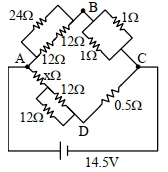
- 6The value of unknown resistance $(x)$ for which the potential difference between $B$ and $D$ will be zero in the arrangement shown, is:View Solution
- 7View SolutionIf the length of potentiometer wire is increased, then the length of the previously obtained balance point will
- 8Two bulbs, one of $50\, watt$ and another of $25\, watt$ are connected in series to the mains. The ratio of the currents through them isView Solution
- 9The $H$ amount of thermal energy is developed by a resistor in $10\,s$ when a current of $4\,A$ is passed through it. If the current is increased to $16\,A$, the thermal energy developed by the resistor in $10\,s$ will be $........\,H$View Solution
- 10A current of $5\; {A}$ is passing through a non-linear magnesium wire of cross-section $0.04\; {m}^{2}$. At every point the direction of current density is at an angle of $60^{\circ}$ with the unit vector of area of cross-section. The magnitude of electric field at every point of the conductor is ....${V} / {m}$ (Resistivity of magnesium is $\rho=44 \times 10^{-8}\, \Omega m$)View Solution