Drift speed of electrons, when $1.5\, A$ of current flows in a copper wire of cross section $5\, mm^2$, is $v$. If the electron density in copper is $9 \times 10^{28}\, m^3$ the value of $v$ in $mm/s$ is close to (Take charge of electron to be $= 1.6 \times 10^{-19}\, C$)
JEE MAIN 2019, Medium


Download our appand get started for free
Experience the future of education. Simply download our apps or reach out to us for more information. Let's shape the future of learning together!No signup needed.*
Similar Questions
- 1Three resistances of magnitude $2$, $3$ and $5$ $ohm$ are connected in parallel to a battery of $10\, volts$ and of negligible resistance. The potential difference across $3\,\Omega $ resistance will be ............... $volts$View Solution
- 2One $kg$ of water, at $20\,^oC$, is heated in an electric kettle whose heating element has a mean (temperature averaged) resistance of $20\, \Omega $. The rms voltage in the mains is $200\, V$. Ignoring heat loss from the kettle, time taken for water to evaporate fully, is close to.......... $\min$ [Specific heat of water $= 4200\, J/kg\, ^oC$), Latent heat of water $= 2260\, k\,J/kg$]View Solution
- 3View SolutionWhen current flows through a conductor, then the order of drift velocity of electrons will be
- 4View SolutionA wire of a certain material is stretched slowly by ten percent. Its new resistance and specific resistance become respectively
- 5The length of a given cylindrical wire is increased by $100 \%$. Due to the consequent decrease in diameter the change in the resistance of the wire will be .................. $\%$View Solution
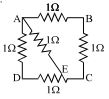
- 6$ABCD$ is a square where each side is a uniform wire of resistance $1\,\Omega$ . $A$ point $E$ lies on $CD$ such that if a uniform wire of resistance $1\,\Omega$ is connected across $AE$ and constant potential difference is applied across $A$ and $C$ then $B$ and $E$ are equipotential.View Solution
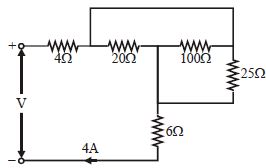
- 7In given circuit find value of ................... $V$View Solution
- 8The resistance of the filament of a lamp increases with the increase in temperature. A lamp rated $100\, W, 220\, V$ is connected across $220\, V$ power supply. If the voltage drops by $10\%$ then the power of lamp will beView Solution
- 9A student measures the terminal potential difference $(V)$ of a cell $($ of $emf \;\varepsilon $ and internal resistance $r)$ as a function of the current $(I)$ flowing through it. The slope, and intercept, of the graph between $V$ and $I$, then, respectively, equalView Solution
- 10Masses of $3$ wires of same metal are in the ratio $1 : 2 : 3$ and their lengths are in the ratio $3 : 2 : 1$. The electrical resistances are in ratioView Solution