Question
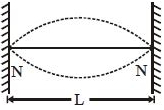
A wire is stretched between two rigid supports vibrates in its fundamental mode with a frequency of $50\,\, Hz$ . The mass of the wire is $30\,\, g$ and its linear density is $4\, \times \, 10^{-2}\,\, kg/m$ . The speed of the transverse wave at the string is  ...... $ms^{-1}$
Answer

Here, mass of the wire, $M=30 \mathrm{\,g}=30 \times 10^{-3} \mathrm{\,kg}$

Mass per unit length of the wire.

$\mu=4 \times 10^{-2} \mathrm{\,kg} \mathrm{m}^{-1}$

$\therefore $ length of the wire, $L=\frac{M}{\mu}$

$=\frac{30 \times 10^{-3} \mathrm{\,kg}}{4 \times 10^{-2} \mathrm{\,kgm}^{-1}}=0.75 \mathrm{\,m}$

For the fundamental mode $\frac{\lambda}{2}=L$

$\Rightarrow \lambda=2 \mathrm{L}=2 \times 0.75=1.5 \mathrm{\,m}$

Speed of the transverse wave.

$\mathrm{v}=\mathrm{n} \lambda=\left(50 \mathrm{\,s}^{-1}\right)(1.5 \mathrm{\,m})=75 \mathrm{\,ms}^{-1}$

Need a full question paper?

Generate a complete, print-ready paper with questions like this in minutes — across 16+ boards, with answer keys.

Start Generating Free

Similar questions

Out of the following functions representing motion of a particle which represents $SHM$ 

$(A)\;y= sin\omega t-cos\omega t$

$(B)\;y=sin^3\omega t$

$(C)\;y=5cos\left( {\frac{{3\pi }}{4} - 3\omega t} \right)$

$(D)\;y=1+\omega t+{\omega ^2}{t^2}$

A $25\times10^{-3}\, m^3$ volume cylinder is filled with $1\, mol$ of $O_2$ gas at room temperature $(300\, K)$. The molecular diameter of $O_2$, and its root mean square speed, are found to be $0.3\, nm$ and $200\, m/s$, respectively. What is the average collision rate (per second) for an $O_2$ molecule?
A square loop is carrying a steady current $I$ and the magnitude of its magnetic dipole moment is $m$. If this square loop is changed to a circular loop and it carries the same current, the magnitude of the magnetic dipole moment of circular loop will be
The equation of a wave is represented by $y = {10^{ - 4}}\sin \,\left[ {100\,t - \frac{x}{{10}}} \right].$ The velocity of the wave will be .... $m/s$
In an ammeter, $5 \%$ of the main current passes through the galvanometer. If resistance of the galvanometer is G, the resistance of ammeter will be :
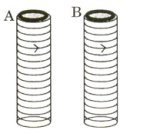
Two metallic rings $\mathrm{A}$ and $\mathrm{B}$, identical in shape and size but having different resistivities $\rho_A$ and $\rho_B$, are kept on top of two identical solenoids as shown in the figure. When current $I$ is switched on in both the solenoids in identical manner, the rings $\mathrm{A}$ and $\mathrm{B}$ jump to heights $h_A$ and $h_B$, respectively, with $h_A>h_B$. The possible relation$(s)$ between their resistivities and their masses $m_A$ and $m_B$ is(are)

$(A)$ $\rho_A>\rho_B$ and $m_A=m_B$

$(B)$ $\rho_A<\rho_B$ and $m_A=m_B$

$(C)$ $\rho_A>\rho_B$ and $m_A > m_B$

$(D)$ $\rho_A<\rho_B$ and $m_A < m_B$

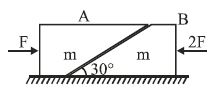
Two blocks $'A$' and $'B'$ each of mass $'m'$ are placed on a smooth horizontal surface. Two horizontal force $F$ and $2F$ are applied on the $2$ blocks $'A'$ and $'B'$ respectively as shown in figure. The block $A$ does not slide on block $B$. Then the normal reaction acting between the two blocks is
When an air bubble of radius $r$ rises from the bottom to the surface of a lake, its radius becomes $\frac{{5r}}{4}$.Taking the atmospheric pressure to be equal to $10\,m$ height of water column, the depth of the lake would approximately be ....... $m$ (ignore the surface tension and the effect of temperature)
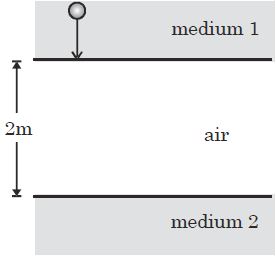
A bead is moving in medium $1$ with a uniform speed of $1\, m \,s^{-1}$ for $2.5\, s$. Then it enters into air and falls freely under gravity for $2\, m$. Finally, it enters medium $2$ and immediately moves with uniform speed for $1.5\, s$. The total distance the bead has traveled, is.........$m$ $(g = 10\, m/s^2$):
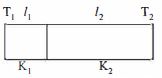
One end of a thermally insulated rod is kept at a temperature $T_1$ and the other at $T_2$ . The rod is composed of two sections of length $l_1$ and $l_2$ and thermal conductivities $K_1$ and $K_2$ respectively. The temperature at the interface of the two section is