A wire is suspended by one end. At the other end a weight equivalent to $20\, N$ force is applied. If the increase in length is $1.0\, mm$, the increase in energy of the wire will be ....... $joule$
Medium


Download our appand get started for free
Experience the future of education. Simply download our apps or reach out to us for more information. Let's shape the future of learning together!No signup needed.*
Similar Questions
- 1The area of a cross-section of steel wire is $0.1\,\,cm^2$ and Young's modulus of steel is $2\,\times \,10^{11}\,\,N\,\,m^{-2}.$ The force required to stretch by $0.1\%$ of its length is ......... $N$.View Solution
- 2View SolutionThe quality of the material which opposes the change in shape, volume or length is called
- 3View SolutionThe following four wires are made of the same material. Which of these will have the largest extension when the same tension is applied?
- 4The ratio of two specific heats of gas ${C_p}/{C_v}$ for argon is $1.6$ and for hydrogen is $1.4$. Adiabatic elasticity of argon at pressure $P$ is $E.$ Adiabatic elasticity of hydrogen will also be equal to $E$ at the pressureView Solution
- 5View SolutionA stretched rubber has
- 6Rod of constant cross-section moves towards right with constant acceleration. Graph of stress and distance from left end is given as in figure. If density of material of rod at cross section $1$ is $9$ $\frac{{gm}}{{c{m^3}}}$ . Find density at cross section $2$.View Solution
.......... $\mathrm{gm} / \mathrm{cm}^{3}$
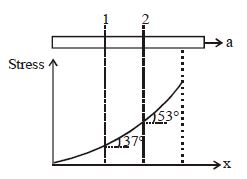
- 7The following four wires of length $L$ and radius $r$ are made of the same material. Which of these will have the largest extension, when the same tension is applied?View Solution
- 8Two blocks of masses $m$ and $M$ are connected by means of a metal wire of cross-sectional area $A$ passing over a frictionless fixed pulley as shown in the figure. The system is then released. If $M = 2\, m$, then the stress produced in the wire isView Solution
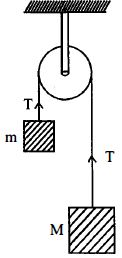
- 9If the ratio of diameters, lengths and Young's modulus of steel and copper wires shown in the figure are $p, q$ and $s$ respectively, then the corresponding ratio of increase in their lengths would beView Solution
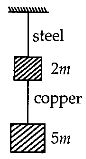
- 10View SolutionWhich one of the following quantities does not have the unit of force per unit area