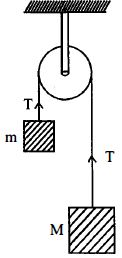
Two blocks of masses $m$ and $M$ are connected by means of a metal wire of cross-sectional area $A$ passing over a frictionless fixed pulley as shown in the figure. The system is then released. If $M = 2\, m$, then the stress produced in the wire is
JEE MAIN 2013, Diffcult
Download our app for free and get started
Tension in the wire, $T = \left( {\frac{{2mM}}{{m + M}}} \right)g.$
$Stress = \frac{{Force/Tension}}{{Area}} = \frac{{2mM}}{{A\left( {m + M} \right)}}g$
$ = \frac{{2\left( {m \times 2m} \right)g}}{{A\left( {m + 2m} \right)}}\left( {M = 2m\,given} \right)$
$ = \frac{{4{m^2}}}{{3mA}}g = \frac{{4mg}}{{3A}}$

Download our appand get started for free
Experience the future of education. Simply download our apps or reach out to us for more information. Let's shape the future of learning together!No signup needed.*
Similar Questions
- 1The maximum elongation of a steel wire of $1 \mathrm{~m}$ length if the elastic limit of steel and its Young's modulus, respectively, are $8 \times 10^8 \mathrm{~N} \mathrm{~m}^{-2}$ and $2 \times 10^{11} \mathrm{~N} \mathrm{~m}^{-2}$, is:View Solution
- 2View SolutionThe isothermal bulk modulus of a gas at atmospheric pressure is
- 3The pressure of a medium is changed from $1.01 × 10^5$ $Pa$ to $1.165 × 10^5$ $Pa$ and change in volume is $10\% $ keeping temperature constant. The Bulk modulus of the medium isView Solution
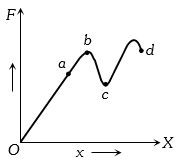
- 4The graph is drawn between the applied force $F$ and the strain $(x)$ for a thin uniform wire. The wire behaves as a liquid in the partView Solution
- 5View SolutionThe ratio of the adiabatic to isothermal elasticities of a triatomic gas is
- 6A wire of length $L$ and radius $r$ is clamped at one end. If its other end is pulled by a force $F$, its length increases by $l$. If the radius of the wire and the applied force both are reduced to half of their original values keeping original length constant, the increase in length will become.View Solution
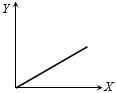
- 7A student plots a graph from his reading on the determination of Young’s modulus of a metal wire but forgets to label. The quantities on $X$ and $Y$ axes may be respectively.View Solution
- 8A pendulum consisting of a small sphere of mass $m$ suspended by an inextensible and massless string of length $l$ is made to swing in a vertical plane. If the breaking strength of the string is $2mg$ , then the maximum angular amplitude of the displacement from the vertical can be ....... $^o$View Solution
- 9View SolutionWhich of the following affects the elasticity of a substance
- 10A compressive force, $F$ is applied at the two ends of a long thin steel rod. It is heated, simultaneously, such that its temperature increases by $\Delta T$. The net change in its length is zero. Let $l$ be the length of the rod, $A$ its area of cross- section, $Y$ its Young's modulus, and $\alpha $ its coefficient of linear expansion. Then, $F$ is equal toView Solution