A wire of length $10 \mathrm{~cm}$ and radius $\sqrt{7} \times 10^{-4} \mathrm{~m}$ connected across the right gap of a meter bridge. When a resistance of $4.5 \ \Omega$ is connected on the left gap by using a resistance box, the balance length is found to be at $60 \mathrm{~cm}$ from the left end. If the resistivity of the wire is $\mathrm{R} \times 10^{-7} \Omega \mathrm{m}$, then value of $\mathrm{R}$ is :
JEE MAIN 2024, Diffcult


Download our appand get started for free
Experience the future of education. Simply download our apps or reach out to us for more information. Let's shape the future of learning together!No signup needed.*
Similar Questions
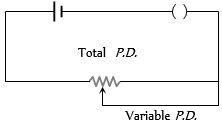
- 1View SolutionThe arrangement as shown in figure is called as
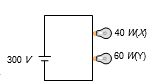
- 2Two bulbs $X$ and $Y$ having same voltage rating and of power $40\, watt$ and $60\, watt$ respectively are connected in series across a potential difference of $300\, volt$, thenView Solution
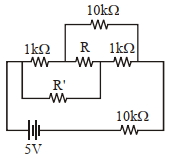
- 3When the resistance $R$ (indicated in the figure below) is changed from $1 \,k \Omega$. to $10 \,k \Omega$, the current flowing through the resistance $R'$ does not change. What is the value of the resistor $R'?$View Solution
- 4In a potentiometer arrangement, a cell of $emf$ $1.25\; V$ gives a balance point at $35.0\; cm$ length of the wire. If the cell is replaced by another cell and the balance point shifts to $63.0\; cm ,$ what is the $emf$ of the second cell in $V$?View Solution
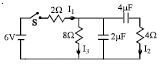
- 5In the circuit shown in the figure, the switch $S$ is initially open and the capacitor is initially uncharged. $ I_1, I_2$ and $I_3$ represent the current in the resistance $2\,\Omega , 4\,\Omega $ and $8\,\Omega$ respectively.View Solution
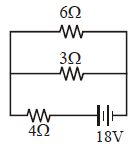
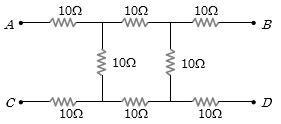
- 6What will be the equivalent resistance between the two points $A$ and $D$ ............. $\Omega$View Solution
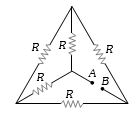
- 7Each of the resistance in the network shown in fig. is equal to $R$. The resistance between the terminals $A$ and $B$ isView Solution
- 8Two wires each of radius of cross section $r$ but of different materials are connected together end to end (in series). If the densities of charge carriers in the two wires are in the ratio $1 : 4$, the drift velocity of electrons in the two wires will be in the ratio:View Solution
- 9A student is provided with a variable voltage source $V$, a test resistor $R_T=10\,\Omega$, two identical galvanometers $G_1$ and $G_2$ and two additional resistors, $R _1=10\,M\,\Omega$ and $R _2=0.001\,\Omega$. For conducting an experiment to verify ohms law, the most suitable circuit is:View Solution
- 10The total power dissipated (in $watt$ ) in the circuit shown isView Solution