A wire of length $5\,m$ and radius $1\,mm$ has a resistance of $1\, ohm$. What length of the wire of the same material at the same temperature and of radius $2\,mm$ will also have a resistance of $1\, ohm$ .............. $m$
Easy


Download our appand get started for free
Experience the future of education. Simply download our apps or reach out to us for more information. Let's shape the future of learning together!No signup needed.*
Similar Questions
- 1A cell of $emf$ $E$ and internal resistance $r$ is connected in series with an external resistacne $nr.$ Then, the ratio of the terminal potential difference to $emf$ isView Solution
- 2A $5\,^oC$ rise in temperature is observed in a conductor by passing a current. When the current is doubled the rise in temperature will be approximately ........... $^oC$View Solution
- 3A potentiometer has uniform potential gradient. The specific resistance of the material of the potentiometer wire is $10^{-7} \, ohm-meter$ and the current passing through it is $0.1\, ampere$; cross-section of the wire is $10^{-6}\, m^2$. The potential gradient along the potentiometer wire isView Solution
- 4What length of the wire of specific resistance $48 \times {10^{ - 8}}\,\Omega \,\,m$ is needed to make a resistance of $4.2 \, \Omega$ .............. $m$ (diameter of wire = $0.4\, mm$)View Solution
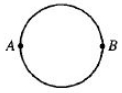
- 5A wire of resistance $12\,ohms$ per meter is bent to form a complete circle of radius $10\, cm.$ The resistance between its two diametrically opposite points, $A$ and $B$ as shown in the figure isView Solution
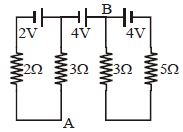
- 6In the given circuit calculate potential difference between $A$ and $B$ ............... $\mathrm{V}$View Solution
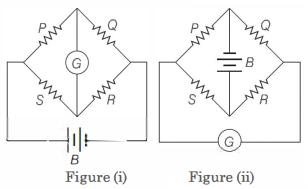
- 7Figure $(i)$ below shows a Wheatstone's bridge in which $P, Q, R$ and $S$ are fixed resistances, $G$ is a galvanometer and $B$ is a battery. For this particular case, the galvanometer shows zero deflection. Now, only the positions of $B$ and $G$ are interchanged, as shown in figure $(ii)$. The new deflection of the galvanometerView Solution
- 8View SolutionThe length of the wire is doubled. Its conductance will be
- 9A cylindrical conductor has uniform cross-section. Resistivity of its material increase linearly from left end to right end. If a constant current is flowing through it and at a section distance $x$ from left end, magnitude of electric field intensity is $E$, which of the following graphs is correctView Solution
- 10View SolutionThe specific resistance of all metals is most affected by