A wire of length $L$ and radius $r$ is clamped at one end. If its other end is pulled by a force $F$, its length increases by $l$. If the radius of the wire and the applied force both are reduced to half of their original values keeping original length constant, the increase in length will become.
JEE MAIN 2024, Diffcult
Download our app for free and get started
$ \mathrm{Y}=\frac{\text { stress }}{\text { strain }} $
$ \mathrm{Y}=\frac{\frac{\mathrm{F}}{\mathrm{r}^2}}{\frac{\ell}{\mathrm{L}}} $
$ \mathrm{F}=\mathrm{Y} \pi \mathrm{r}^2 \times \frac{\ell}{\mathrm{L}} $ $...........(i)$
$ \mathrm{Y}=\frac{\frac{\pi \mathrm{r}^2 / 4}{\Delta \ell}}{\mathrm{L}} $
$ \mathrm{F}=\mathrm{Y} \frac{\Delta \ell}{\mathrm{L}} \times 2 \times \frac{\pi \mathrm{r}^2}{4} $
$ \text { From }(\mathrm{i}) $
$ \mathrm{Y} \pi \mathrm{r}^2 \frac{\ell}{\mathrm{L}}=\mathrm{Y} \frac{\Delta \ell}{\mathrm{L}} \frac{\pi \mathrm{r}^2}{2} $
$ \Delta \ell=2 \ell$

Download our appand get started for free
Experience the future of education. Simply download our apps or reach out to us for more information. Let's shape the future of learning together!No signup needed.*
Similar Questions
- 1One end of a horizontal thick copper wire of length $2 L$ and radius $2 R$ is welded to an end of another horizontal thin copper wire of length $L$ and radius $R$. When the arrangement is stretched by a applying forces at two ends, the ratio of the elongation in the thin wire to that in the thick wire is :View Solution
- 2View SolutionWith rise in temperature, the Young's modulus of elasticity
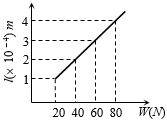
- 3The adjacent graph shows the extension $(\Delta l)$ of a wire of length $1m$ suspended from the top of a roof at one end with a load $W$ connected to the other end. If the cross sectional area of the wire is ${10^{ - 6}}{m^2},$ calculate the young’s modulus of the material of the wireView Solution
- 4The work per unit volume to stretch the length by $1\%$ of a wire with cross sectional area of $1\,m{m^2}$ will be. $[Y = 9 \times {10^{11}}\,N/{m^2}]$View Solution
- 5An Indian rubber cord $L$ metre long and area of cross-section $A$ $metr{e^2}$ is suspended vertically. Density of rubber is $D$ $kg/metr{e^3}$ and Young's modulus of rubber is $E$ $newton/metr{e^2}$. If the wire extends by $l$ metre under its own weight, then extension $l$ isView Solution
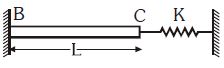
- 6A rod $BC$ of negligible mass fixed at end $B$ and connected to a spring at its natural length having spring constant $K = 10^4\ N/m$ at end $C$, as shown in figure. For the rod $BC$ length $L = 4\ m$, area of cross-section $A = 4 × 10^{-4}\ m^2$, Young's modulus $Y = 10^{11} \ N/m^2$ and coefficient of linear expansion $\alpha = 2.2 × 10^{-4} K^{-1}.$ If the rod $BC$ is cooled from temperature $100^oC$ to $0^oC,$ then find the decrease in length of rod in centimeter.(closest to the integer)View Solution
- 7A horizontal steel railroad track has a length of $100 \,m$, when the temperature is $25^{\circ} C$. The track is constrained from expanding or bending. The stress on the track on a hot summer day, when the temperature is $40^{\circ} C$ is ............. $\times 10^7\,Pa$ (Note : The linear coefficient of thermal expansion for steel is $1.1 \times 10^{-5} /{ }^{\circ} C$ and the Young's modulus of steel is $2 \times 10^{11} \,Pa$ )View Solution
- 8View SolutionWith rise in temperature, the Young's modulus of elasticity
- 9View SolutionWhich of the following statements is correct
- 10View SolutionThe material which practically does not show elastic after effect is