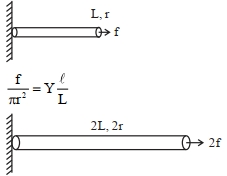
A wire of length $L$ and radius $r$ is clamped rigidly at one end. When the other end of the wire is pulled by a force $f$, its length increases by $l$. Another wire of same material of length $2 L$ and radius $2 r$ is pulled by a force $2 f$. Then the increase in its length will be
JEE MAIN 2023, Medium


Download our appand get started for free
Experience the future of education. Simply download our apps or reach out to us for more information. Let's shape the future of learning together!No signup needed.*
Similar Questions
- 1The Young's modulus of a wire is $Y.$ If the energy per unit volume is $E$, then the strain will beView Solution
- 2View SolutionAccording to Hook’s law of elasticity, if stress is increased, the ratio of stress to strain
- 3Two wires are made of the same material and have the same volume. The first wire has cross-sectional area $A$ and the second wire has cross-sectional area $3A$. If the length of the first wire is increased by $\Delta l$ on applying a force $F$, how much force is needed to stretch the second wire by the same amount?View Solution
- 4The work done in increasing the length of a $1$ $metre$ long wire of cross-section area $1\, mm^2$ through $1\, mm$ will be ....... $J$ $(Y = 2\times10^{11}\, Nm^{-2})$View Solution
- 5If a spring extends by $x$ on loading, then the energy stored by the spring is (if $T$ is tension in the spring and $k$ is spring constant)View Solution
- 6Two wires of same length and radius are joined end to end and loaded. The Young's modulii of the materials of the two wires are $Y_{1}$ and $Y_{2}$. The combination behaves as a single wire then its Young's modulus is:View Solution
- 7A steel wire is $1 \,m$ long and $1 \,mm ^2$ in area of cross-section. If it takes $200 \,N$ to stretch this wire by $1 \,mm$, how much force will be required to stretch a wire of the same material as well as diameter from its normal length of $10 \,m$ to a length of $1002 \,cm$ is ........ $N$View Solution
- 8The force required to stretch a steel wire of $1\,c{m^2}$ cross-section to $1.1$ times its length would be $(Y = 2 \times {10^{11}}\,N{m^{ - 2}})$View Solution
- 9View SolutionThe Bulk Modulus for an incompressible liquid is
- 10The compressibility of water is $6 \times 10^{-10} N ^{-1} m ^{2} .$ If one litre is subjected to a pressure of $4 \times 10^{7} Nm ^{-2}$ the decrease in its volume is (in $cc$)View Solution