A wire of resistance $20 \Omega$ is divided into $10$ equal parts. A combination of two parts are connected in parallel and so on. Now resulting pairs of parallel combination are connected in series. The equivalent resistance of final combination is_______.0$\Omega$.
JEE MAIN 2024, Diffcult
Download our app for free and get started
Each part has resistance $=2 \Omega$
$2$ parts are connected in parallel so, $R=1 \Omega$
Now, there will be 5 parts each of resistance $1 \Omega$, they are connected in series.
$\mathrm{R}_{\mathrm{xq}}=5 \mathrm{R}, \mathrm{R}_{\mathrm{sq}}=5 \Omega$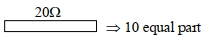

Download our appand get started for free
Experience the future of education. Simply download our apps or reach out to us for more information. Let's shape the future of learning together!No signup needed.*
Similar Questions
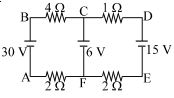
- 1The figure shows a network of four resistances and three batteries The electrical power dissipated as heat is .............. $W$View Solution
- 2On interchanging the resistances, the balance point of a meter bridge shifts to the left by $10\ cm$. The resistance of their series combination is $1\ k\Omega$. How much was the resistance on the left slot before interchanging the resistances? .................. $\Omega$View Solution
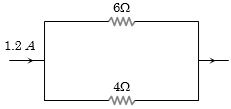
- 3In the figure given below, the current passing through $6\,\Omega $ resistor is ........... $ampere$View Solution
- 4$n$ identical cells are joined in series with its two cells $A$ and $B$ in the loop with reversed polarities. $EMF$ of each shell is $E$ and internal resistance $r$. Potential difference across cell $A$ or $B$ is (here $n > 4$)View Solution
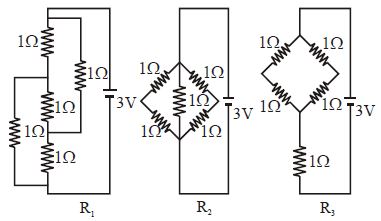
- 5Figure shows three resistor configurations $R_1,R_2$ and $R_3$ connected to $3\,V$ battery. If the power dissipated by the configuration $R_1, R_2$ and $R_3$ is $P_1, P_2$ and $P_3$ , respectively thenView Solution
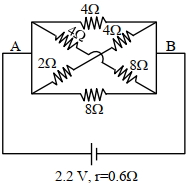
- 6In the given figure, the $emf$ of the cell is $2.2\, {V}$ and if internal resistance is $0.6\, \Omega$. Calculate the power dissipated in the whole circuit: (in $W$)View Solution
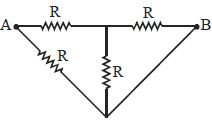
- 7Find equivalent resistance $A$ and $B$View Solution
- 8A cell of internal resistance $r$ drives current through an external resistance $R$ . The power delivered by the cell to the external resistance will be maximum when:View Solution
- 9$A$ current $I$ flows through a uniform wire of diameter $d$ when the mean electron drift velocity is $V$. The same current will flow through a wire of diameter $d/2$ made of the same material if the mean drift velocity of the electron is :View Solution
- 10In the circuit shown, the energy stored in the capacitor is $n\,\mu J$. The value of $n$ is ..............View Solution