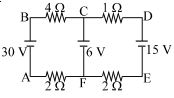
The figure shows a network of four resistances and three batteries The electrical power dissipated as heat is .............. $W$
Diffcult


Download our appand get started for free
Experience the future of education. Simply download our apps or reach out to us for more information. Let's shape the future of learning together!No signup needed.*
Similar Questions
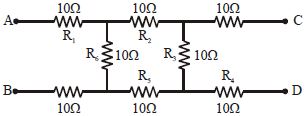
- 1The equivalent resistance between the points $A$ and $D$ ................ $\Omega$View Solution
- 2The effective resistance of a parallel connection that consists of four wires of equal length, equal area of cross-section and same material is $0.25\, \Omega$. What will be the effective resistance if they are connected in series ? (In $\Omega$)View Solution
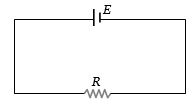
- 3Consider the circuit given here with the following parameters $E.M.F.$ of the cell = $12\, V$. Internal resistance of the cell $ = 2\,\Omega $. Resistance $R = 4\,\Omega $ Which one of the following statements in trueView Solution
- 4View SolutionEmf is most closely related to
- 5Four wires of the same diameter are connected in turn between two points, maintained at a constant potential difference. Their resistivities are; $\rho $ and $L$ (wire $1$ )., $1.2\,\rho $ and $1.2\,L$ (wire $2$ ), $0.9\,\rho $ and $0.9\,L$ (wire $3$ ) and $\rho $ and $1.5\,L$ (wire $4$ ). Rank the wires according to the rates at which energy is dissipated as heat, greatest firstView Solution
- 6$50\,\Omega $ and $100\,\Omega $ resistors are connected in series. This connection is connected with a battery of $2.4\, volts$. When a voltmeter of $100\,\Omega $ resistance is connected across $100\,\Omega $ resistor, then the reading of the voltmeter will be ............. $V$View Solution
- 7View SolutionIdentify the set in which all the three materials are good conductors of electricity
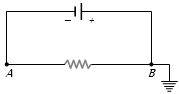
- 8A battery is connected to a uniform resistance wire $AB$ and $B$ is earthed. Which one of the graphs below shows how the current density $J$ varies along $AB$View Solution
- 9The temperature dependence of resistances of $Cu$ and undoped $Si$ in the temperature range $300-400\ K$, is best described byView Solution
- 10If a wire of resistance $20\,\Omega $ is covered with ice and a voltage of $210\, V$ is applied across the wire, then the rate of melting of ice is .................. $g/s$View Solution