The following four wires are made of the same material and are at the same temperature. Which one of them has highest electrical resistance
Easy


Download our appand get started for free
Experience the future of education. Simply download our apps or reach out to us for more information. Let's shape the future of learning together!No signup needed.*
Similar Questions
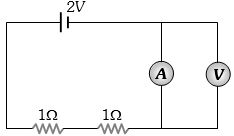
- 1In the circuit shown, $A$ and $V$ are ideal ammeter and voltmeter respectively. Reading of the voltmeter will be ............... $V$View Solution
- 2View SolutionA thick wire is stretched so that its length become two times. Assuming that there is no change in its density, then what is the ratio of change in resistance of wire to the initial resistance of wire
- 3For a wire $\frac{R}{l}=\frac{1}{2}$ and length of wire is $l=5\, cm .$ If potential difference $1\, V$ is applied across it, current through wire will be: $( R =$ Resistance $)$ (in $A$)View Solution
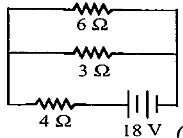
- 4The total power dissipated in watt in the circuit shown here is ............. $W$View Solution
- 5An electric lamp is marked $60\, W$, $230\, V$. The cost of a $1\, kWh$ of energy is Rs. $1.25$. The cost of using this lamp $8$ hrs a day for $30$ day is Rs. ...............View Solution
- 6A wire of length $5\,m$ and radius $1\,mm$ has a resistance of $1\, ohm$. What length of the wire of the same material at the same temperature and of radius $2\,mm$ will also have a resistance of $1\, ohm$ .............. $m$View Solution
- 7Three resistors each of $4\,\Omega $ are connected together to form a network. The equivalent resistance of the network cannot be ............ $\Omega$View Solution
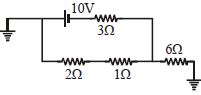
- 8Find current in $6\,\Omega $ resistanceView Solution
- 9When a current $I$ is passed through a wire of constant resistance, it produces a potential difference $V$ across its ends. The graph drawn between $\log\, I$ and $\log\, V$ will beView Solution
- 10A wire of resitance $R$ and length $L$ is cut into $5$ equal part. if these parts are joined parts are joined paralley, than result resistance will be:View Solution