A small spherical solid ball is dropped from a great height in a viscous liquid. Its journey in the liquid is best described in the diagram given below by the
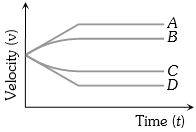
  • ACurve $A$
  • BCurve $B$
  • CCurve $ C$ 
  • DCurve $ D$
Easy
art

Download our app
and get started for free

Experience the future of education. Simply download our apps or reach out to us for more information. Let's shape the future of learning together!No signup needed.*

Similar Questions

  • 1
    Mumbai needs $1.4 \times 10^{12} L$ of water annually. Its effective surface area is $600 \,km ^2$ and it receives an average rainfall of $2.4 \,m$ annually. If $10 \%$ of this rain water is conserved, it will meet approximately
    View Solution
  • 2
    $Assertion :$ A bubble comes from the bottom of a lake to the top.
    $Reason :$ Its radius increases.
    View Solution
  • 3
    A balloon of mass $m$ contains water of mass $M$ . If it is completely immersed in water, find the apparent mass of the balloon with water in it
    View Solution
  • 4
    Three liquids of densities $d,\,2d$ and $3d$ are mixed in equal proportions of weights. The relative density of the mixture is
    View Solution
  • 5
    Rank in order, from highest to lowest, the liquid heights $h_a$ to $h_d$ .The air flow is from left to right. The liquid columns are not drawn to scale
    View Solution
  • 6
    A small spherical monoatomic ideal gas bubble $\left(\gamma=\frac{5}{3}\right)$ is trapped inside a liquid of density $\rho_{\ell}$ (see figure). Assume that the bubble does not exchange any heat with the liquid. The bubble contains n moles of gas. The temperature of the gas when the bubble is at the bottom is $\mathrm{T}_0$, the height of the liquid is $\mathrm{H}$ and the atmospheric pressure is $\mathrm{P}_0$ (Neglect surface tension).

    Figure: $Image$

    $1.$ As the bubble moves upwards, besides the buoyancy force the following forces are acting on it

    $(A)$ Only the force of gravity

    $(B)$ The force due to gravity and the force due to the pressure of the liquid

    $(C)$ The force due to gravity, the force due to the pressure of the liquid and the force due to viscosity of the liquid

    $(D)$ The force due to gravity and the force due to viscosity of the liquid

    $2.$ When the gas bubble is at a height $\mathrm{y}$ from the bottom, its temperature is

    $(A)$ $\mathrm{T}_0\left(\frac{\mathrm{P}_0+\rho_0 \mathrm{gH}}{\mathrm{P}_0+\rho_t \mathrm{gy}}\right)^{2 / 5}$

    $(B)$ $T_0\left(\frac{P_0+\rho_t g(H-y)}{P_0+\rho_t g H}\right)^{2 / 5}$

    $(C)$ $\mathrm{T}_0\left(\frac{\mathrm{P}_0+\rho_t \mathrm{gH}}{\mathrm{P}_0+\rho_t \mathrm{gy}}\right)^{3 / 5}$

    $(D)$ $T_0\left(\frac{P_0+\rho_t g(H-y)}{P_0+\rho_t g H}\right)^{3 / 5}$

    $3.$ The buoyancy force acting on the gas bubble is (Assume $R$ is the universal gas constant)

    $(A)$ $\rho_t \mathrm{nRgT}_0 \frac{\left(\mathrm{P}_0+\rho_t \mathrm{gH}\right)^{2 / 5}}{\left(\mathrm{P}_0+\rho_t \mathrm{gy}\right)^{7 / 5}}$

    $(B)$ $\frac{\rho_{\ell} \mathrm{nRgT}_0}{\left(\mathrm{P}_0+\rho_{\ell} \mathrm{gH}\right)^{2 / 5}\left[\mathrm{P}_0+\rho_{\ell} \mathrm{g}(\mathrm{H}-\mathrm{y})\right]^{3 / 5}}$

    $(C)$ $\rho_t \mathrm{nRgT} \frac{\left(\mathrm{P}_0+\rho_t g \mathrm{H}\right)^{3 / 5}}{\left(\mathrm{P}_0+\rho_t g \mathrm{~g}\right)^{8 / 5}}$

    $(D)$ $\frac{\rho_{\ell} \mathrm{nRgT}_0}{\left(\mathrm{P}_0+\rho_{\ell} \mathrm{gH}\right)^{3 / 5}\left[\mathrm{P}_0+\rho_t \mathrm{~g}(\mathrm{H}-\mathrm{y})\right]^{2 / 5}}$

    Give the answer question $1,2,$ and $3.$

    View Solution
  • 7
    For the situation shown in the figure, water flows on the surface of a fixed plate. The
    velocity of water as a function of distance $'y'$ is given as : $u = \alpha \left[ {\frac{y}{h} - 2{{\left( {\frac{y}{h}} \right)}^2}} \right]$ . Determine the magnitude of the shear stress that the water applies at the base of the plate. Coefficient of viscosity is $\eta$
    View Solution
  • 8
    A machine is blowing spherical soap bubbles of different radii filled with helium gas.It is found that, if the bubbles have a radius smaller than $1\,cm$, then they sink to the floor in still air. Larger bubbles float in the air. Assume that the thickness of the soap film in all bubbles is uniform and equal. Assume that the density of soap solution is same as that of water $\left(=1000 \,kg m ^{-3}\right)$. The density of helium inside the bubbles and air are $0.18 \,kg m ^{-3}$ and $1.23 \,kg m ^{-3}$, respectively. Then, the thickness of the soap film of the bubbles is .......... $\mu m$ (Note $1 \,\mu m =10^{-6} \,m$ )
    View Solution
  • 9
    A large tank filled with water to a height ‘h’ is to be emptied through a small hole at the bottom. The ratio of time taken for the level of water to fall from $ h$  to $\frac{h}{2}$ and from $\frac{h}{2}$ to zero is
    View Solution
  • 10
    Figure below shows a liquid being pushed out of the tube by a piston having area of cross section $2.0\,cm ^2$. The area of cross section at the outlet is $10\,mm ^2$. If the piston is pushed at a speed of $4\,cm s ^{-1}$, the speed of outgoing fluidis $.........\,cm s ^{-1}$.
    View Solution